

Bartakke Enclosures
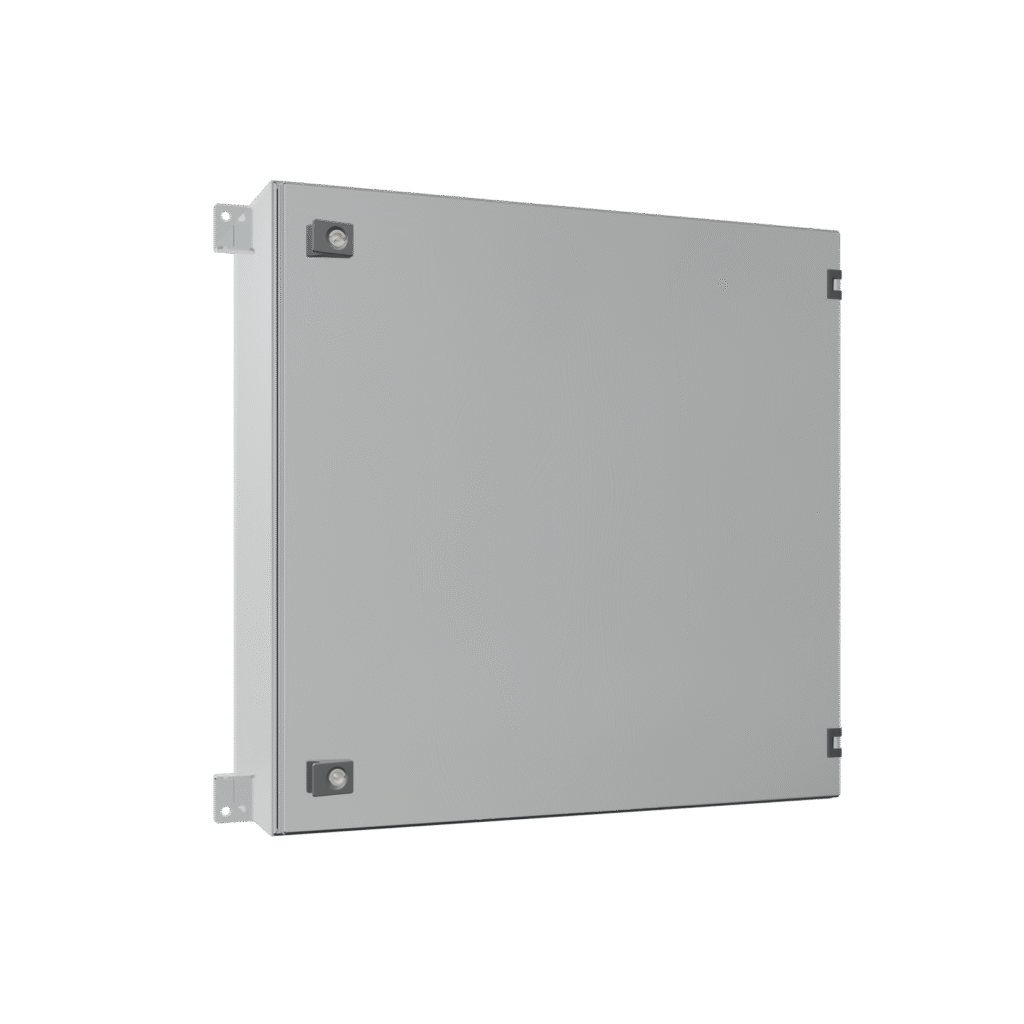
An electrical enclosure is a protective housing — usually metal or non-metallic — that shields switchgear, control panels, wiring, and electronic components from dust, moisture, corrosion, and accidental contact. Enclosures are rated by standards like IP (Ingress Protection) and NEMA, and are selected based on the environment they operate in, from indoor control rooms to outdoor substations.
Key takeaways
- An electrical enclosure protects components such as breakers, terminals, relays, PLCs, power supplies, and wiring from dust, water, corrosion, impact, and unsafe contact.
- Enclosures are classified by installation type (wall-mount, floor-mount, freestanding), environment (indoor, outdoor, hazardous area), and material (mild steel, SS304, SS316, non-metallic).
- IP ratings (IP54-IP68) tell you exactly what an enclosure resists — the first digit is solids, the second is liquids.
- Material choice, not just IP rating, determines long-term service life — a mild steel enclosure and an SS316 enclosure can carry the same IP66 rating and still perform very differently in a coastal or chemical plant.
- Common buying mistakes include choosing by price alone, ignoring corrosion risk, and undersizing the enclosure for future cable and component needs.
What is the purpose of an electrical enclosure?
An electrical enclosure exists to create a safe barrier between electrical components and everything around them — people, weather, dust, and corrosive substances. Most enclosures are designed to manage several risks at once:
- Dust and dirt — keeping particles away from terminals, contacts, and sensitive control equipment
- Water and moisture — blocking rain, washdown spray, humidity, and condensation
- Corrosion — reducing damage in coastal, chemical, and food-processing environments
- Impact and vibration — protecting components in factories, machinery lines, and outdoor installations
- Unsafe contact — lowering the risk of a person accidentally touching a live part
- Unauthorized access — locks and latches to prevent tampering or theft
Get any one of these wrong, and the failure usually shows up months later — as a tripped breaker, a corroded terminal, or an unplanned shutdown — rather than on day one.
Types of electrical enclosures
Enclosures are generally classified in three ways, and most buying decisions involve all three at once.
By installation type:
- Wall-mount enclosures — smaller footprint, mounted directly to a wall or structure
- Floor-mount enclosures — for larger equipment loads, standing independently
- Freestanding enclosures — full-height cabinets, often used for switchgear and control rooms
By environment:
- Indoor enclosures — dry, controlled conditions with lower ingress requirements
- Outdoor enclosures — built for rain, UV exposure, and temperature swings
- Hazardous-area enclosures — for zones where flammable gases, vapours, or dust may be present, requiring ATEX or PESO-certified, explosion-proof construction
By material:
- Mild steel — cost-effective for dry indoor use
- Stainless steel (SS304 / SS316) — for outdoor, washdown, and corrosive environments
- Non-metallic (polyester/FRP) — for aggressive chemical exposure where metal isn’t ideal
Enclosure type | Best for | Typical IP rating | Example use case |
Wall-mount, mild steel | Dry indoor panels | IP54-IP55 | Factory control room distribution board |
Wall-mount, SS304 | Outdoor, general industrial | IP65-IP66 | Outdoor junction box near a process line |
Floor-mount, SS316 | Coastal / chemical sites | IP66 | Pump house control panel near seawater intake |
Freestanding, mild steel | Indoor switchgear rooms | IP42-IP54 | LT panel room in a manufacturing plant |
Hazardous-area (ATEX) | Zone 1 / Zone 2 areas | IP65-IP66 + Ex rating | Gas processing plant field instrumentation |
Electrical enclosure materials compared
Material is often the most under-evaluated part of an enclosure purchase — buyers compare IP ratings without asking what the box is made of, and two enclosures with an identical IP66 rating can have very different service lives depending on the base material and coating quality.
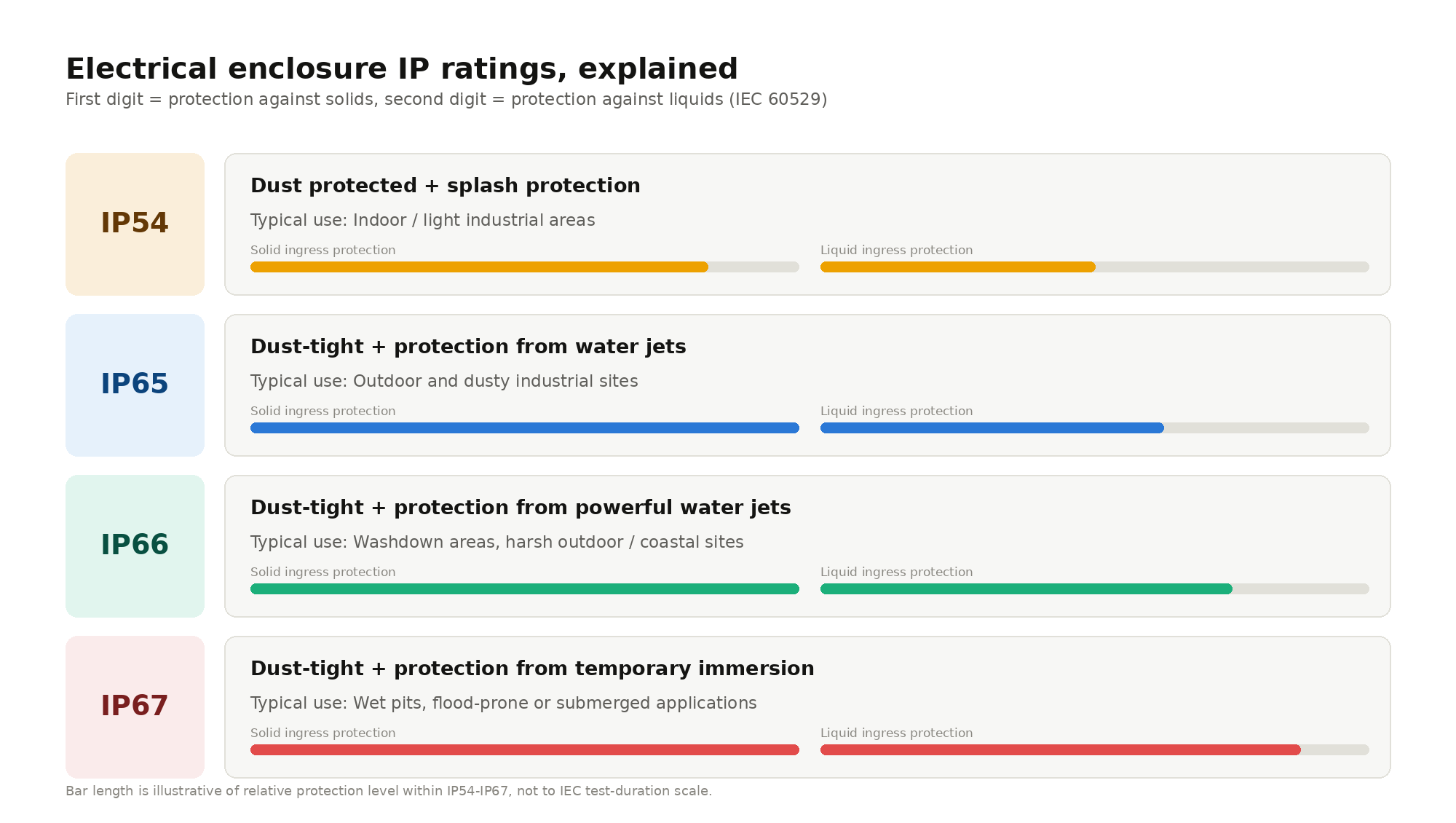
[Electrical enclosure IP ratings, explained: what each rating covers and where it’s typically used]
![Electrical enclosure materials compared: mild steel, SS304, SS316, and non-metallic against corrosion resistance and best-fit environment]](https://bartakkeenclosures.com/wp-content/uploads/2026/09/electrical-enclosure-material-comparison.png)
[Electrical enclosure materials compared: mild steel, SS304, SS316, and non-metallic against corrosion resistance and best-fit environment]
As a quick reference:
- Mild steel is strong and economical for dry, indoor, low-corrosion environments — provided it carries a proper powder coating.
- SS304 handles general outdoor exposure and light corrosive conditions well and is the most common stainless choice for industrial sites.
- SS316 adds molybdenum, which specifically resists chloride attack — the standard choice for coastal, marine, and chemical-process environments.
- Non-metallic (polyester/FRP) enclosures resist corrosion by nature rather than coating, useful in wastewater treatment and areas with corrosive gas exposure.
IP ratings explained
An IP (Ingress Protection) rating tells you exactly what an enclosure resists, using two digits defined under IEC 60529. The first digit rates protection against solid objects and dust; the second rates protection against liquids.
IP rating | Protection level | Typical use |
IP54 | Dust protected, splash protection | Indoor or light industrial areas |
IP65 | Dust-tight, protected against water jets | Outdoor and dusty industrial sites |
IP66 | Dust-tight, protected against powerful water jets | Washdown areas, harsh outdoor and coastal sites |
IP67 | Dust-tight, protected against temporary immersion | Wet pits, flood-prone or submerged applications |
A higher number isn’t automatically “better” — it’s only useful when it matches the real environment. Specifying IP67 for a dry indoor panel adds cost without adding value; specifying IP54 for a coastal washdown site will fail early.
How to choose the right electrical enclosure?
Selection comes down to five sequential decisions:
- Define the installation environment. Indoor, outdoor, washdown, coastal, chemical, or hazardous-area — this decision drives everything else.
- Match the IP or certification requirement. Use the table above as a starting point, and check whether the site also requires a hazardous-area certification such as ATEX or PESO.
- Select the material. Weigh upfront cost against corrosion exposure and expected service life — not just the sticker price of the enclosure.
- Plan the internal layout. Leave room for cable bends, ventilation, and future components; undersized enclosures cause more field problems than any other single specification error.
- Confirm compliance requirements. ISO 9001:2015 manufacturing, CE marking, and (where applicable) ATEX or IECEx certification should be confirmed before ordering, not after installation.
Electrical enclosures in hazardous areas
Not every enclosure decision is about dust and rain. In facilities that handle flammable gases or combustible dust — oil and gas processing, biogas and Bio-CNG plants, battery manufacturing, and chemical processing — enclosures also need to avoid becoming an ignition source themselves.
These applications call for ATEX or PESO-certified, explosion-proof enclosures, or purged and pressurised enclosures that keep standard electronics safely isolated from the surrounding hazardous atmosphere. If your project involves a classified hazardous area, see our dedicated guide to ATEX-certified enclosures for zone classification and equipment selection.
Total cost of ownership: why coating and build quality matter
The purchase price of an enclosure is a small fraction of its lifetime cost. Corrosion, seal degradation, and coating failure are the most common reasons enclosures need early replacement — and all three are driven by build quality decisions made before the enclosure ever leaves the factory.
A few things worth checking with any manufacturer:
- Coating process — powder coating cycles and pre-treatment (degreasing, phosphating) determine how well a coating resists chipping and corrosion over years, not just in a showroom
- Salt spray test performance — a documented salt spray rating is a far better indicator than a visual inspection
- Gasket and seal quality — a degraded gasket silently downgrades an IP66 enclosure within a year or two
- Weld and joint finishing — poorly finished welds are where corrosion typically starts first, regardless of the base material
Enclosures built with advanced coating systems, such as C4-H (high corrosivity) compliant powder coating, are engineered to extend service life in high-humidity, salt-exposed, or industrially polluted environments — the same conditions that cause standard-coated enclosures to fail early.
Common mistakes when selecting an electrical enclosure
- Choosing by price only. The cheapest enclosure rarely has the right seal, coating thickness, or material for the environment it ends up in.
- Using an indoor-rated enclosure outdoors. Indoor enclosures aren’t built for UV exposure, wind-driven rain, or large temperature swings.
- Ignoring corrosion risk. Coastal, chemical, and washdown sites need a material decision, not just an IP rating.
- Assuming all enclosures with the same IP rating are equal. IP rating measures ingress resistance at the time of testing — it says nothing about coating durability, weld quality, or gasket life over years of field use.
- Undersizing the enclosure. Leaving no room for cable bends, ventilation, or future components creates maintenance problems long after installation.
- Missing certification requirements. Projects requiring ISO, CE, ATEX, or other specific standards can face installation delays if this is confirmed too late in the process.
Conclusion
Choosing the right electrical enclosure is rarely just about matching a box to a size requirement. It’s a decision that combines environment, material, IP rating, internal layout, and compliance — and getting any one of these wrong tends to show up as a maintenance problem well after installation, not before.
For projects that need enclosures built for demanding industrial, outdoor, or hazardous-area conditions, explore Bartakke’s mild steel enclosures (encloPRIME) and stainless steel enclosures (encloINOX), both manufactured under ISO 9001:2015 with IP65/IP66-rated protection as standard.
Frequently Asked Questions
1. What is the main purpose of an electrical enclosure?
An electrical enclosure protects components such as breakers, terminals, relays, PLCs, and wiring from dust, water, corrosion, impact, and unsafe contact, while keeping the system organised for inspection and maintenance.
2. What materials are electrical enclosures made from?
The most common materials are mild steel (for dry indoor use), stainless steel grades SS304 and SS316 (for outdoor, washdown, and corrosive environments), and non-metallic materials like polyester or FRP (for aggressive chemical exposure).
3. What is the difference between an enclosure and a cabinet?
The terms are often used interchangeably, but “cabinet” typically refers to a larger enclosure designed to house more complex equipment — such as switchgear, PLCs, or multiple control devices — while “enclosure” is the broader term covering everything from small junction boxes to full cabinets.
4. How do I choose the right IP rating for my enclosure?
Match the rating to your actual environment rather than defaulting to the highest number available. IP54 suits dry indoor areas, IP65 fits general outdoor and dusty sites, and IP66 or higher is appropriate for washdown, coastal, or harsh outdoor conditions.
5. Can electrical enclosures be customized for specific industries?
Yes. Manufacturers commonly customize enclosures with specific cutouts, mounting plates, cable gland positions, ventilation, and certifications (such as ATEX for hazardous areas) to match the requirements of industries like pharmaceuticals, data centers, oil and gas, and renewable energy.
6. Do electrical enclosures need ventilation or cooling?
Not always — it depends on the heat load of the components inside. Enclosures housing VFDs, power supplies, or PLCs that generate significant heat may need vents, fans, filters, or cabinet air conditioners to prevent overheating.