

Bartakke Enclosures
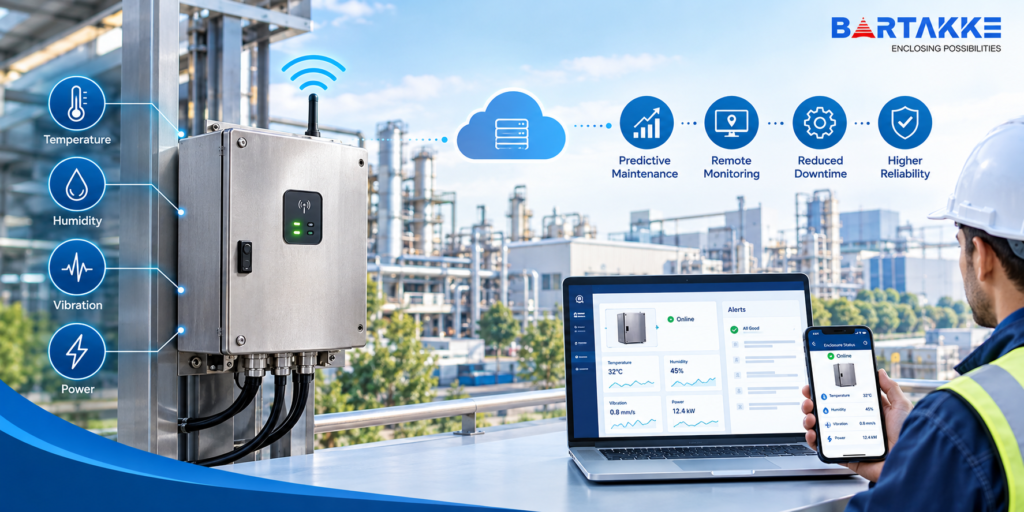
Smart enclosures embed sensors that track internal temperature, humidity, and door status in real time, feeding data to a monitoring platform so maintenance teams can predict failures before they happen. Around 42% of enclosure manufacturers are now investing in IoT-enabled designs, making this one of the fastest-growing trends in industrial enclosure specification.
Key takeaways
- A smart enclosure adds sensors and connectivity so the enclosure reports its own condition in real time.
- Core sensors track internal temperature, humidity, door status, and power conditions.
- Predictive maintenance catches overheating and moisture ingress before they cause shutdowns.
- Retrofit kits make smart monitoring possible without replacing existing enclosures.
- It pays off most at remote, unmanned, or high-downtime-cost sites.
What makes an enclosure “smart”?
A smart enclosure is an electrical enclosure fitted with sensors and a communication gateway that continuously monitors the conditions inside it and report them to a remote dashboard. Instead of waiting for a technician to open the door and find a problem, the enclosure flags the problem itself.
A standard enclosure is passive: it protects what’s inside and says nothing about its own condition. Overheating, condensation, a failed fan, or a door left open all go unnoticed until something trips or fails. A smart enclosure turns each of those into a measurable signal. The enclosure stops being just protection and becomes a source of condition data for the equipment it houses.
This is different from general IoT predictive maintenance, which usually monitors machines such as motors, pumps, and compressors. Here, the enclosure itself, and the control gear inside it, is the monitored asset.
Common sensor types
Most smart enclosure deployments combine a handful of sensor types, each tied to a specific failure it helps prevent.
Sensor | What it detects | Failure it prevents | Typical use |
Temperature | Internal heat rise | Overheating, premature component ageing | Panels with drives, PLCs, power supplies |
Humidity / condensation | Moisture buildup | Corrosion, tracking, short circuits | Outdoor, coastal, and washdown sites |
Door / tamper switch | Door open, forced entry | Unauthorised access, left-open doors | Unmanned substations, telecom sites |
Ingress / leak sensor | Water entry at base or seals | Water damage, seal failure | Outdoor and flood-prone locations |
Power quality monitor | Voltage and current anomalies | Component stress, nuisance trips | Critical process and data loads |
Smoke / heat alarm | Thermal events | Fire escalation | High-density or high-load panels |
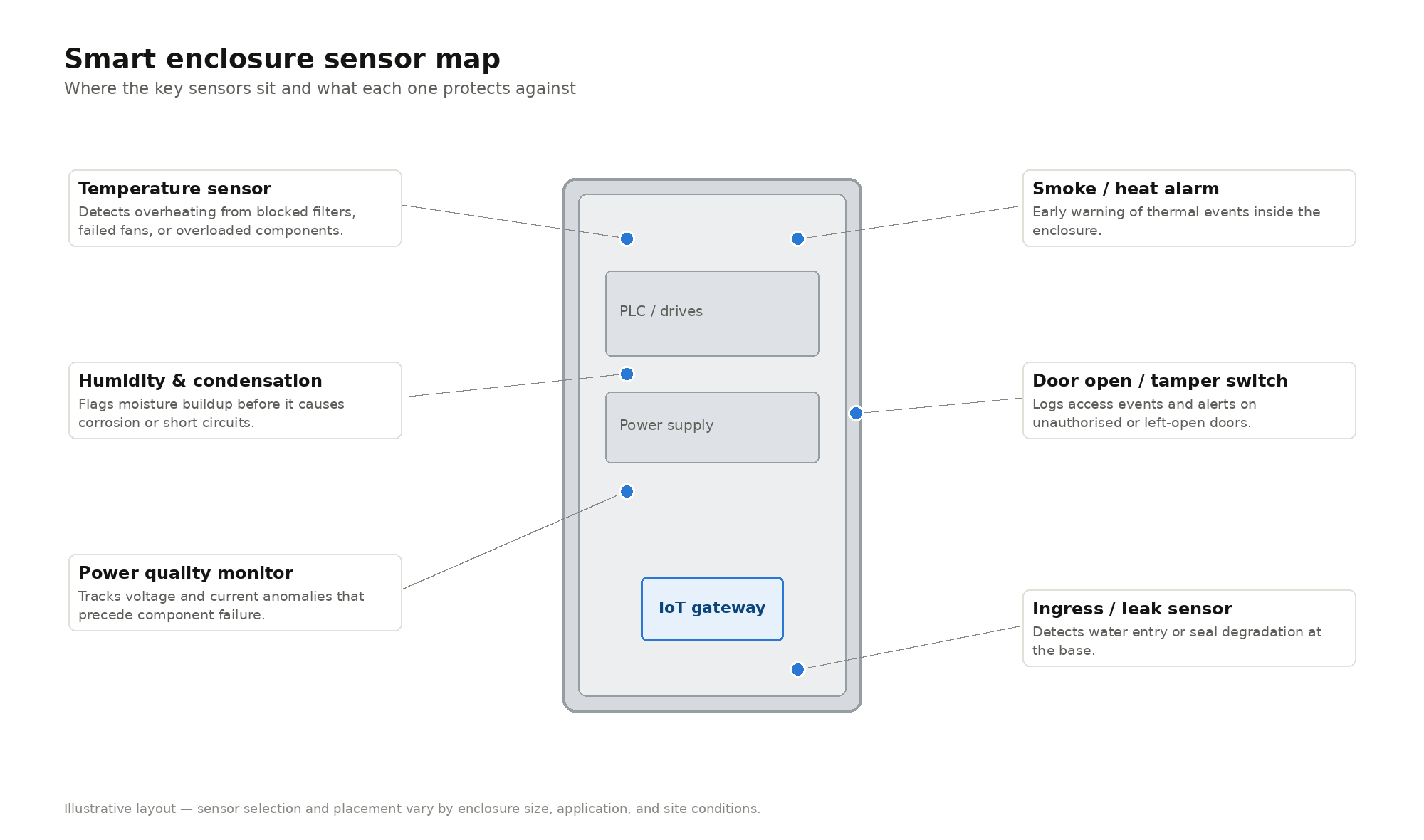
Fig 1: Smart enclosure sensor map
Not every enclosure needs every sensor. A dry indoor control panel may only need temperature and door monitoring, while a coastal outdoor cabinet benefits most from humidity and ingress sensing.
How it works?: from sensor to alert
The monitoring chain is simple in principle and follows four steps:
- Sensors capture conditions. Temperature, humidity, door state, and power readings are collected inside the enclosure.
- A gateway transmits the data. It aggregates readings and sends them securely over wired or wireless links.
- A dashboard visualises trends. Live readings are compared against thresholds set for that enclosure and site.
- An alert triggers action. When a reading crosses a threshold, or a trend points toward failure, the maintenance team is notified before the equipment goes down.
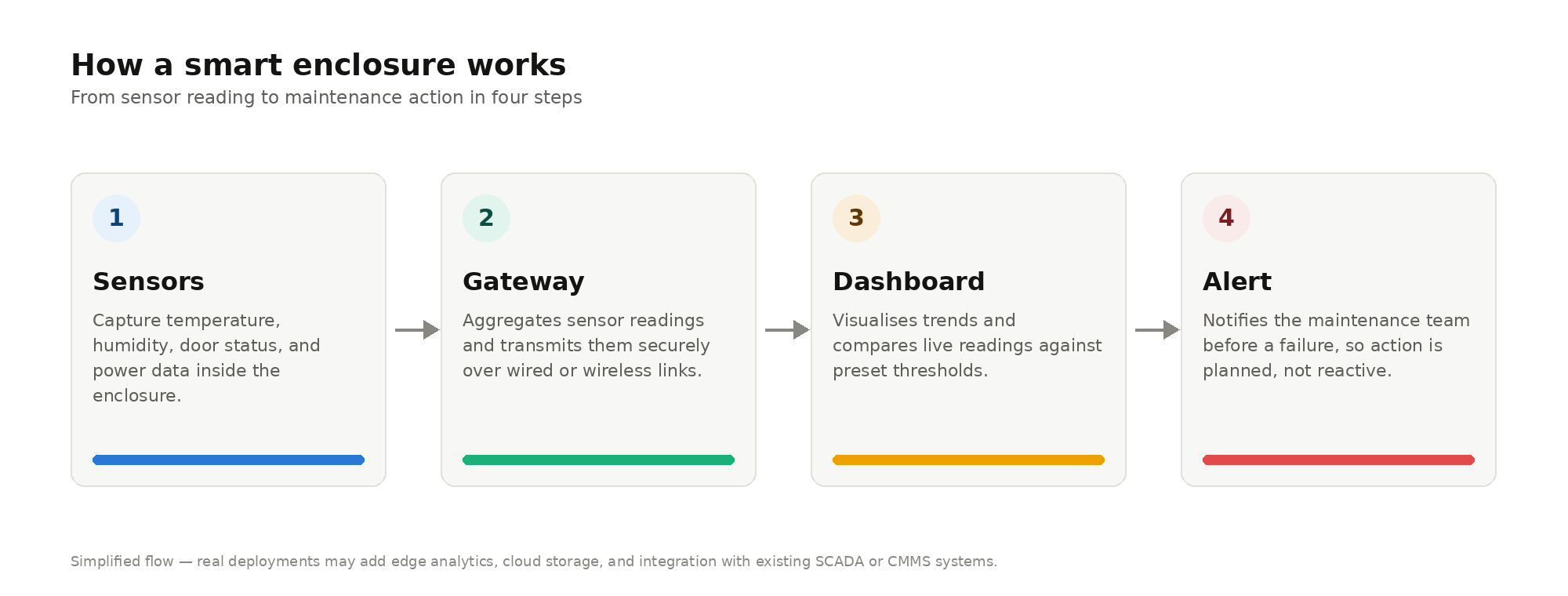
Fig 2: How a smart enclosure works
The value sits in step 4. An alert about rising temperature on a Tuesday is a planned filter change. The same problem discovered on Friday night is an unplanned shutdown.
Predictive maintenance benefits
Predictive maintenance replaces calendar-based servicing (“inspect every six months”) with condition-based servicing (“inspect when the data says something is changing”). For enclosures, that brings several practical benefits:
- Less unplanned downtime. Overheating and moisture problems are caught while they are still small.
- Longer component life. Keeping internal temperature and humidity in range reduces stress on drives, PLCs, and power supplies.
- Fewer unnecessary site visits. Technicians go where data shows a problem, not on a fixed loop, which matters at remote sites.
- Better maintenance records. Logged data gives a time-stamped history for root-cause analysis and audits.
Remote monitoring and alerts
Remote monitoring lets one team watch many enclosures from a single screen. Good setups typically include:
- Configurable thresholds for each sensor, set to match the equipment and environment
- Tiered alerts, such as a warning at a rising trend and a critical alert at a limit breach
- Escalation paths, so an unacknowledged alert reaches the next person automatically
- Event logs, recording door openings, alarms, and responses for traceability
This is most valuable where sites are unmanned or hard to reach, such as solar plants, telecom shelters, pumping stations, and remote substations. In those cases, the first sign of trouble is otherwise a failure.
Industries adopting smart enclosures first
Adoption is strongest where downtime is expensive or sites are hard to staff:
- Data centers, where thermal management is critical
- Renewable energy, with solar and wind sites that are often remote and unmanned
- Telecom, with large numbers of distributed cabinets
- Water and wastewater, where humidity and corrosion are constant risks
- Process and manufacturing plants, where a single panel failure can stop a line
For more on enclosure options in these settings, see our electrical and automation enclosures and data center enclosures.
Smart enclosures in hazardous areas
Smart monitoring raises one caution that generic IoT guides skip. Sensors, gateways, and wireless modules are electrical devices, and in a classified hazardous area (where flammable gases or combustible dust may be present) they can become an ignition source.
Any monitoring electronics used in these zones must be intrinsically safe or housed in a suitably certified enclosure, matched to the zone and gas group. Alternatively, the sensing hardware can sit outside the hazardous area, with only certified components inside it. If your site includes classified zones, review requirements first through our guide to ATEX-certified enclosures.
Is it worth it for your plant?
Smart monitoring isn’t automatically the right call for every enclosure. Ask these questions:
- What does an hour of downtime cost? The higher the cost, the stronger the case.
- How hard is the site to reach? Remote sites gain the most from remote monitoring.
- Is heat or humidity a known problem? Harsh conditions make condition data more valuable.
- Do you already have monitoring in place? Building on an existing SCADA or CMMS setup lowers integration effort.
For many plants, the decision is between retrofitting existing enclosures and specifying smart-ready ones for new installations:
Retrofit to existing enclosures | Built-in / smart-ready from the start | |
Upfront effort | Lower; add sensor kits to what you have | Higher; specified at the design stage |
Disruption | Needs a planned shutdown to install | None; installed before commissioning |
Fit and finish | Depends on available space and cable entries | Mounting points and entries planned in advance |
Best for | Critical legacy panels | New projects and large rollouts |
A practical approach is to start with a pilot on your highest-risk or hardest-to-reach enclosures, measure the results, and then expand.
Conclusion
Smart enclosures turn a passive protective box into a source of condition data. Used well, that data lets teams fix problems on their own schedule instead of reacting to failures, especially at remote or high-downtime-cost sites. Start with the enclosures where a failure costs the most, confirm hazardous-area requirements where they apply, and expand from there.
To discuss enclosures for monitored or automated installations, explore Bartakke’s electrical and automation enclosures and data center enclosures, manufactured under ISO 9001:2015 with IP65/IP66-rated protection as standard.
Frequently Asked Questions
1. What sensors are commonly used in smart enclosures?
The most common are temperature, humidity or condensation, door or tamper switches, ingress or leak sensors, and power quality monitors. Some installations also add smoke or heat detection. The right mix depends on the site’s environment and the equipment inside.
2. How does predictive maintenance reduce downtime?
It detects early warning signs, such as rising internal temperature or increasing humidity, and alerts the maintenance team before a component fails. Teams can then fix the issue during planned maintenance instead of responding to an unplanned shutdown.
3. Can existing enclosures be retrofitted with IoT sensors?
Yes, in many cases. Sensor kits and gateways can be added to existing enclosures, provided there is space inside, a suitable power source, and a way to bring in cabling without compromising the enclosure’s IP rating. Any new cable entry should be sealed properly to keep the original ingress protection intact.
4. What industries benefit most from smart enclosures?
Industries with high downtime costs or remote sites benefit most: data centers, renewable energy, telecom, water and wastewater, and process manufacturing.
5. Does Bartakke offer IoT-ready enclosure options?
Bartakke enclosures can be specified with provisions that support sensor integration, such as mounting plates, cable entries, and space for gateways, which can be discussed at the specification stage. Contact our engineering team with your monitoring requirements to confirm what suits your project.
6. Are smart enclosures safe to use in hazardous areas?
Only if the monitoring electronics are certified for the zone. Sensors and gateways in classified areas must be intrinsically safe or housed in an appropriately certified enclosure. Standard IoT devices should not be installed in a hazardous area.