

Bartakke Enclosures
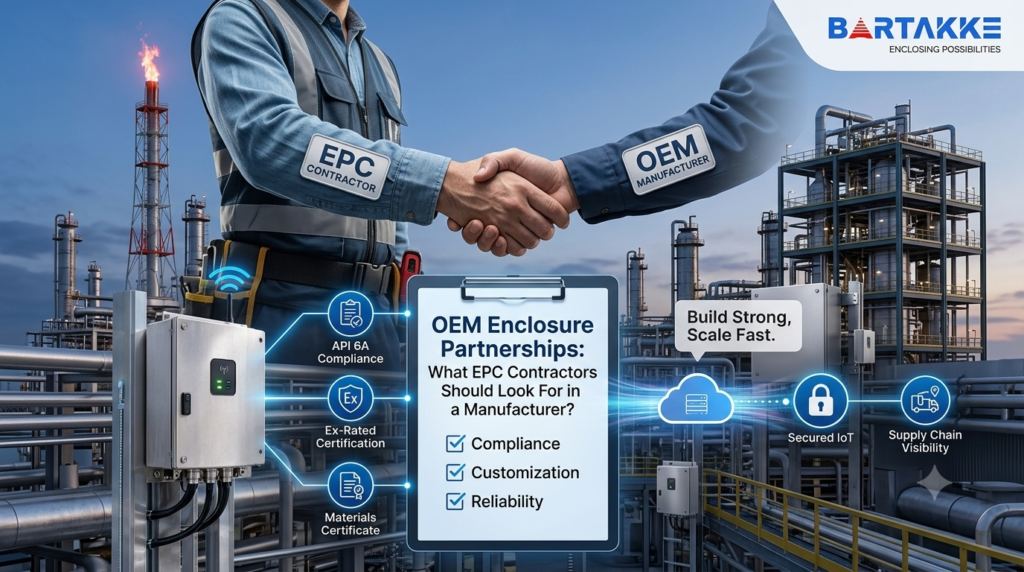
EPC contractors choosing an OEM enclosure partner should evaluate design flexibility, certification coverage (ATEX, IECEx, IP/NEMA), production capacity, and on-time delivery track record – not just unit price. A weak enclosure vendor can delay an entire project’s commissioning schedule, so vetting manufacturing capability matters as much as the quote.
Key takeaways
- Evaluate design flexibility, certifications, capacity, and delivery record, not unit price alone.
- A late enclosure delivery can hold up commissioning for the whole project.
- Certification coverage (ATEX, IECEx, PESO, IP/NEMA) should match the project’s zones and regions.
- Ask for evidence: test reports, certificates, references, and capacity data.
- Long-term partnerships cut re-qualification effort, lead times, and project risk.
Why does enclosure sourcing affect EPC timelines?
Enclosures rarely get the attention of turbines, transformers, or compressors, yet they sit squarely on the critical path. Control panels, junction boxes, and instrument housings can’t be wired, tested, or energised until the enclosures arrive. Everything downstream waits on them: panel assembly, factory acceptance testing, site installation, and commissioning.
That makes enclosure sourcing a schedule risk, not a purchasing detail. Three failure patterns show up repeatedly on EPC projects:
- Late delivery. A vendor underestimates its own capacity, and panel builders sit idle.
- Wrong or non-compliant product. An enclosure arrives without the certification the zone requires, forcing rework or replacement.
- Quality issues found late. Poor coating or weak sealing shows up at site, where fixes are slow and expensive.
Each one costs far more than the price difference between a cheap quote and a reliable vendor.
Key evaluation criteria
A sound vendor evaluation looks at five areas. Together they predict whether the vendor can deliver the right product, on time, every time.
Design and customisation flexibility
EPC projects rarely fit catalogue sizes. Panels need custom cutouts, specific cable gland positions, mounting plates, ventilation, and sometimes unusual dimensions. A capable OEM partner has an in-house engineering team that can turn a drawing into a manufacturable design, and can suggest changes that reduce cost or lead time.
Certification coverage
Certifications must match the project, not just look impressive on a brochure. Check coverage across:
- Hazardous-area certification (ATEX, IECEx, and PESO in India) for any classified zone
- Ingress protection (IP65/IP66, or NEMA where the client specifies it)
- Quality management (ISO 9001:2015)
- Product marking such as CE for relevant export markets
Verify that each certificate covers the specific product and scope you are buying. For projects with hazardous areas, review the options in our guide to ATEX-certified enclosures.
Production capacity and process control
Ask how much the vendor can produce per month and what happens if a machine fails. Capacity includes cutting, bending, welding, coating, and assembly, and any one of these can become the bottleneck. Manufacturers with disciplined, lean processes tend to give more predictable schedules than those that rely on heroic last-minute effort.
Lead time and delivery record
A quoted lead time means little without a track record behind it. Ask for on-time delivery history and speak to references on similar projects. Be wary of promises that are much shorter than the market norm.
Quality and testing evidence
Coating thickness, weld quality, and gasket performance decide how an enclosure ages in the field. Ask for documented testing: salt-spray results, ingress protection tests, and inspection records.
Vendor-evaluation checklist
Use this table to compare shortlisted vendors side by side.
Criterion | What to verify | Evidence to request | Red flag |
Certifications | Coverage matches project zones and regions | Valid certificates with scope and expiry | Certificate doesn’t cover the actual product |
Design flexibility | Custom sizes, cutouts, materials | Past custom jobs, sample drawings | Catalogue-only offering |
Capacity | Throughput for your volume and schedule | Plant size, line capacity, backup plan | Single line, no fallback |
Lead time | Realistic schedule tied to commissioning | On-time delivery record, client references | Vague or unusually short promises |
Quality and testing | Coating, weld, and ingress testing | Test reports, salt-spray and IP data | No documented testing |
Support | Engineering help and a clear contact | Named contact, response commitments | No single point of contact |
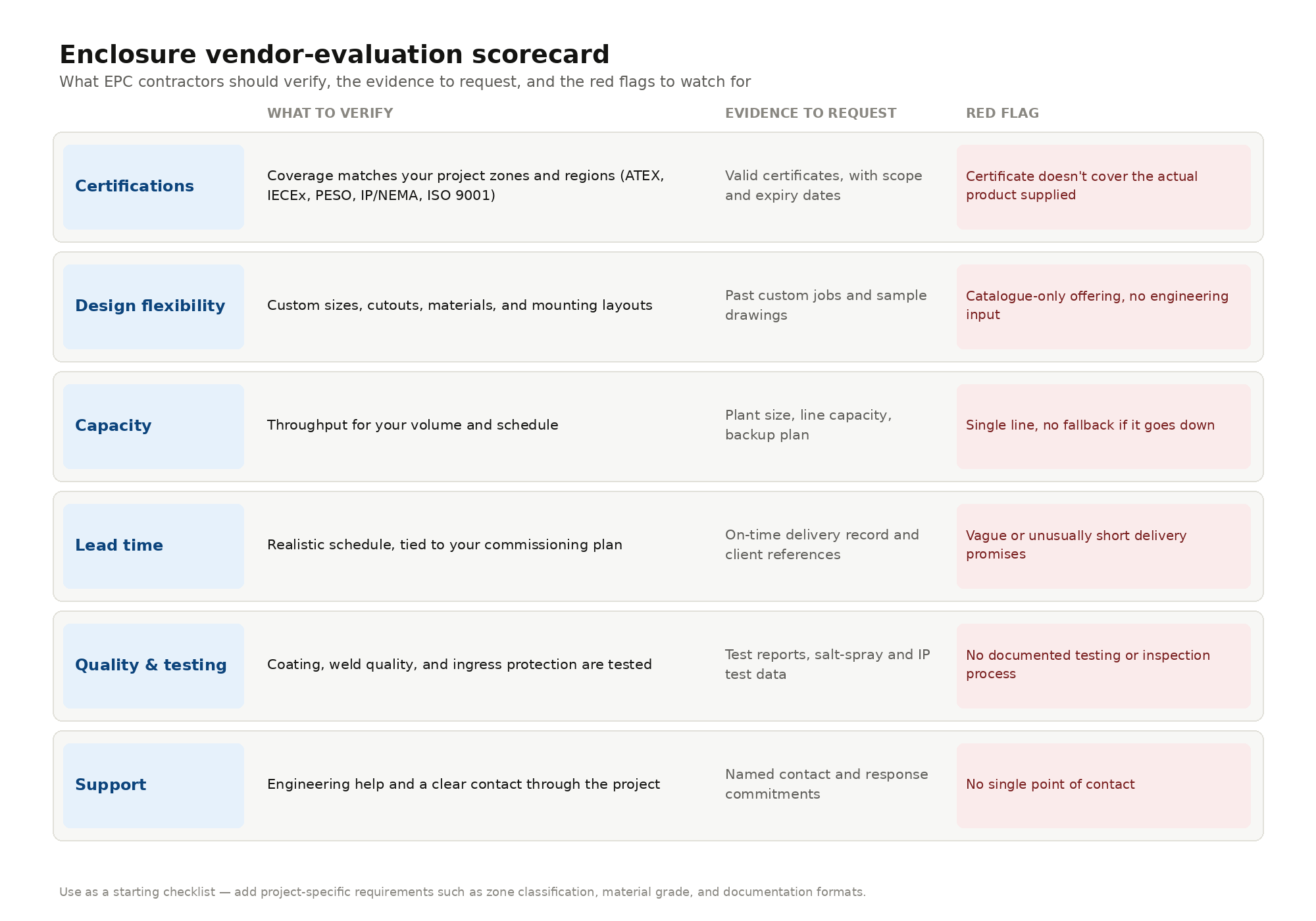
Fig 1: Enclosure vendor-evaluation scorecard
Questions to ask a potential vendor
Put these to every shortlisted manufacturer. The quality of the answers is often more revealing than the answers themselves.
On certifications
- Which certificates cover the exact enclosure I’m buying, and when do they expire?
- Can you supply certificate copies and test reports with each shipment?
On capacity and delivery
- What is your monthly capacity for this enclosure type, and how much of it is already committed?
- What is your on-time delivery record on projects of this size, and can I speak to a reference?
On design and quality
- Can your team review my drawings and suggest manufacturability improvements?
- What coating system do you use, and what are the salt-spray test results?
On support and contract terms
- Who is my single point of contact, and what is the response time for technical queries?
- How do you handle design changes and rework, and who bears the cost?
Red flags to watch for
Some warning signs show up early, if you know where to look:
- Certificates that don’t match the product. A valid certificate for a different model or scope is not cover for yours.
- No test evidence. Claims about coating or ingress protection with no reports behind them.
- No references. A vendor unwilling to connect you with past clients is rarely a good sign.
- Opaque capacity. Evasive answers on plant size, lines, or current workload.
- A quote far below the rest. Unusually low prices often mean thinner material, lighter coating, or corners cut elsewhere.
- No engineering input. A vendor that only quotes and never questions a drawing is unlikely to catch your mistakes.
Why long-term partnerships beat one-off orders?
Treating enclosure supply as a series of one-off purchases means re-doing the same work every time: qualifying the vendor, rebuilding specifications, and re-negotiating schedules. A long-term partnership removes much of that repeated effort.
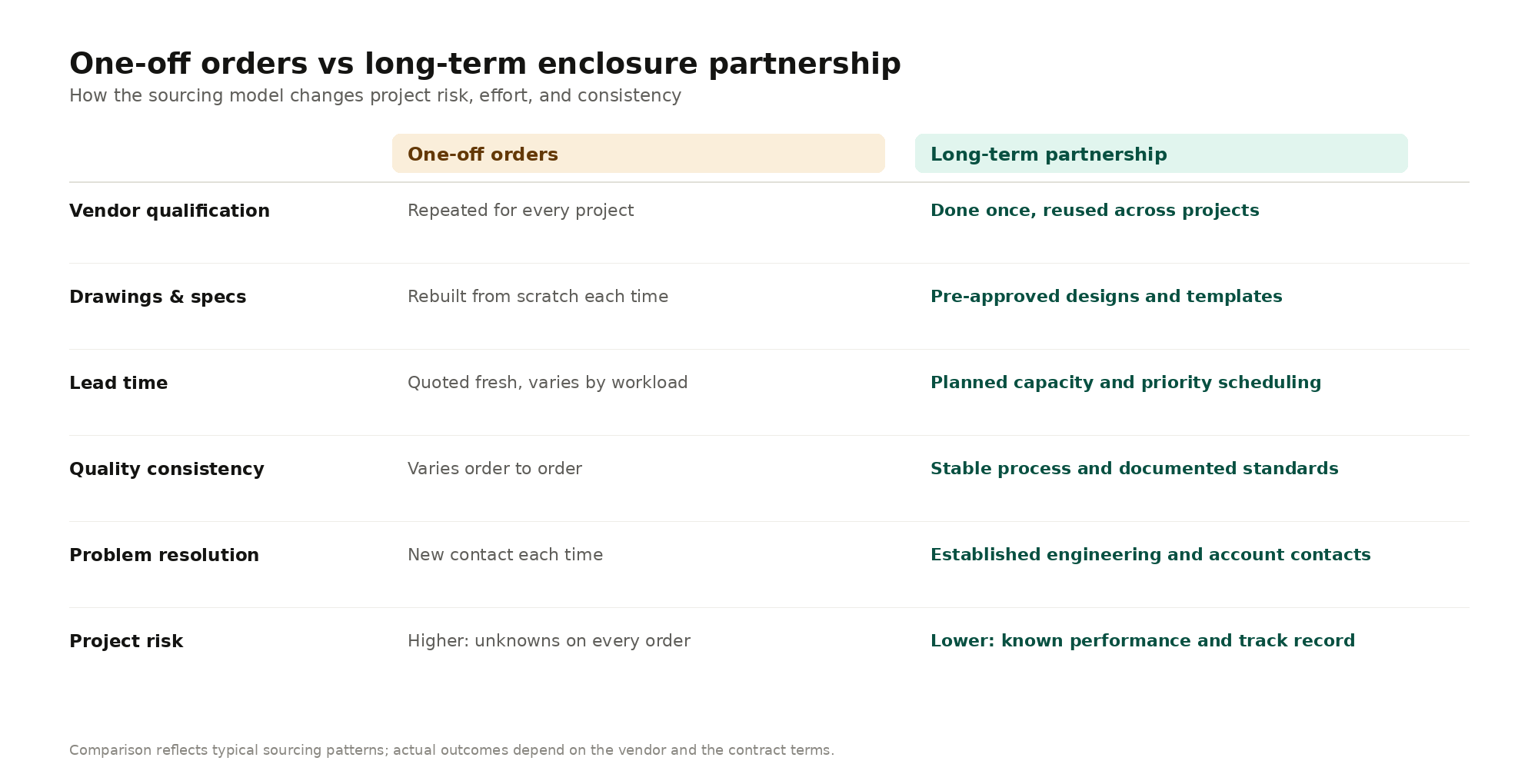
Fig 2: One-off orders vs long-term enclosure partnership
One-off orders | Long-term partnership | |
Vendor qualification | Repeated for every project | Done once, reused |
Drawings and specs | Rebuilt from scratch | Pre-approved designs and templates |
Lead time | Quoted fresh, varies with workload | Planned capacity and priority scheduling |
Quality consistency | Varies order to order | Stable process and documented standards |
Problem resolution | New contact each time | Established engineering and account contacts |
Project risk | Higher, with unknowns on every order | Lower, with known performance |
For EPC contractors running several projects a year, the biggest gain is predictability. A vendor who already knows your standards, drawing formats, and documentation requirements can move faster and make fewer mistakes.
Conclusion
On an EPC project, the enclosure vendor’s reliability matters far more than the unit price on the quote. Evaluate certification coverage, capacity, delivery record, and testing evidence, ask for proof, and favour partners who can support you across projects, not just one order.
To discuss your requirements, explore Bartakke’s OEM and EPC industry enclosures and manufacturing capabilities, or request a quote. Bartakke manufactures mild steel, stainless steel (SS304, SS316), and ATEX-certified enclosures under ISO 9001:2015, serving customers across 30+ export markets.
Frequently Asked Questions
1. What certifications should an enclosure OEM partner hold?
At minimum, ISO 9001 for quality management and tested ingress protection ratings such as IP65/IP66. For hazardous-area projects, look for ATEX or IECEx certification, and PESO approval in India. Always confirm that the certificate scope covers the specific product you are buying.
2. How far in advance should EPC contractors engage an enclosure supplier?
As early as the design stage, ideally before panel specifications are frozen. Early engagement allows the vendor to review drawings, flag manufacturability issues, and reserve production capacity, which protects the schedule.
3. Can one manufacturer handle multiple enclosure types for a project?
Often, yes. A manufacturer with mild steel, stainless steel, and certified hazardous-area ranges can supply most of a project’s enclosures from a single source, which simplifies coordination, documentation, and delivery. Check that the vendor’s capacity and certifications genuinely cover each type, rather than assuming they do.
4. What questions should I ask before signing an OEM enclosure contract?
Ask about certification scope, monthly capacity, on-time delivery record, testing evidence, change-order handling, and who your point of contact will be. Also clarify warranty terms and what happens if a delivery is late.
5. Does Bartakke offer dedicated account management for EPC clients?
Bartakke works with EPC and OEM clients on custom enclosure requirements, supported by an in-house engineering team. For details on account management and project support, contact our team through the quote page.
6. How do I verify an enclosure manufacturer’s certificates are genuine?
Request copies and check them against the issuing body’s records or database where available. Confirm the certificate number, product scope, validity dates, and that the manufacturer’s name and address match. For hazardous-area products, make sure the certificate covers the exact model and zone rating you need.