

Bartakke Enclosures
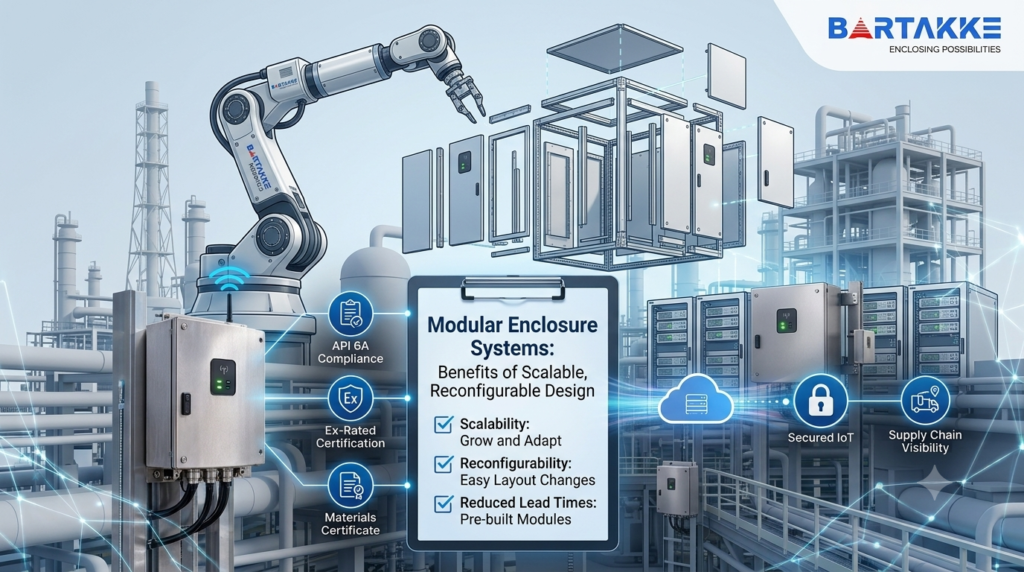
Modular enclosures are built from standardized, expandable sections that let facilities add capacity or reconfigure layouts without replacing the entire unit. A growing share of new enclosure product launches now focus on modularity, reflecting demand from industries that need to scale infrastructure quickly, like data centers and renewable energy sites.
Key takeaways
- Modular enclosures are built from standardised sections that can be added or rearranged without replacing the whole unit.
- The main benefits are scalability, less downtime during expansion, and lower lifecycle cost.
- They work best where capacity grows in stages: data centers, renewable energy sites, and automation lines.
- Upfront cost can be higher, and joined sections need care to keep the IP rating intact.
- Specify the grid, expansion plan, and ratings upfront, because they are hard to change later.
What makes an enclosure modular?
A modular enclosure is an enclosure system built from standard sections, frames, or panels that connect on a common grid, so the assembled unit can be extended or rearranged instead of being rebuilt. Each section is designed to join to the next, and accessories such as mounting plates, doors, and cable entries fit across the whole range.
A fixed enclosure is the opposite: a one-off unit sized for today’s equipment. It works well when the load is known and stable. When the plant grows, the usual answer is to replace the unit, rewire it, and shut down the process while that happens.
Four elements define a modular system:
- Standard sections or frames that can be ordered in repeatable sizes
- A common mounting grid, so internal plates and components line up from one section to the next
- Defined joints, typically bolted or interlocking, with gaskets at each connection
- Shared accessories, such as doors, plinths, and cable entries, that work across the range
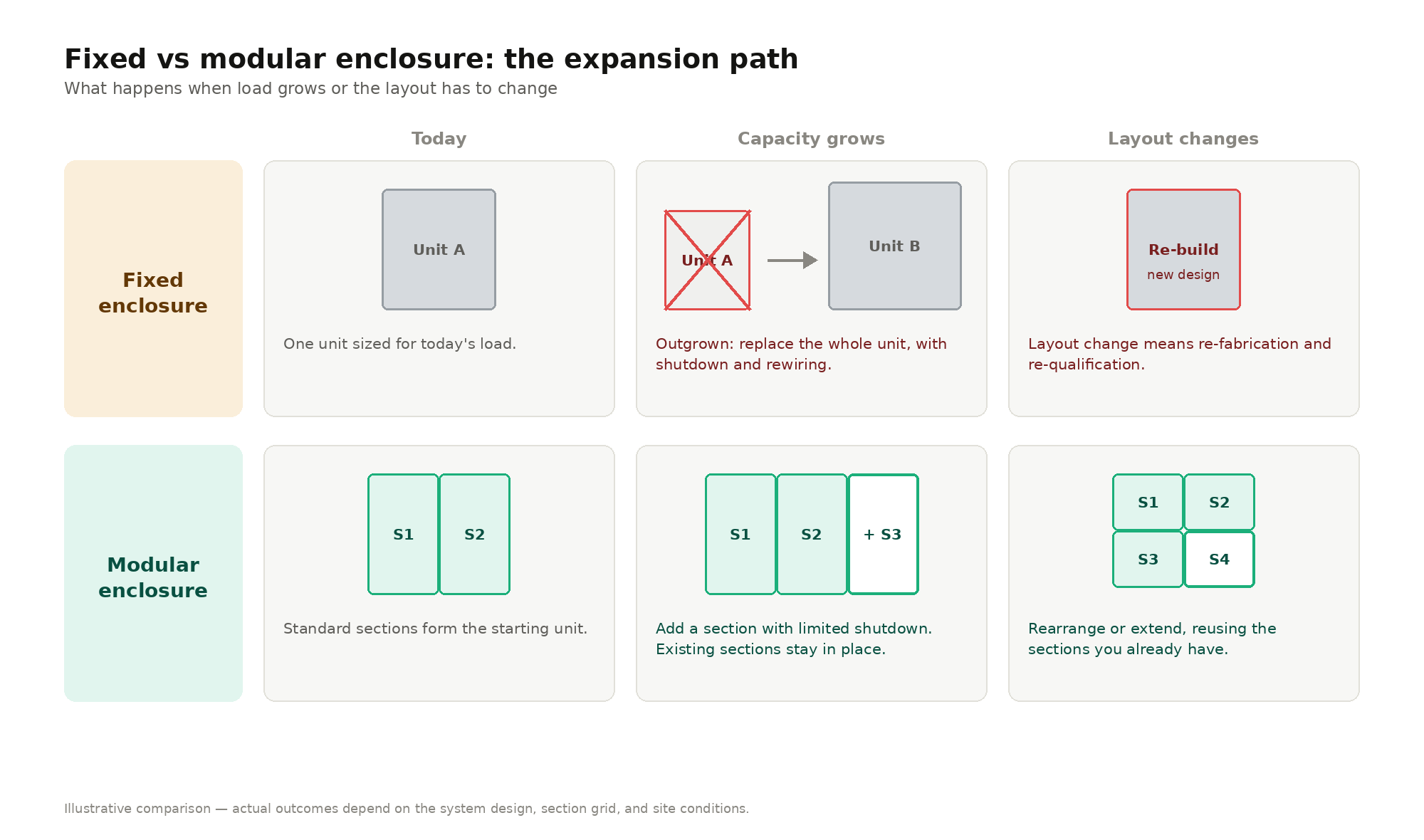
Fig 1: Fixed vs modular enclosure, the expansion path
Key benefits
The benefits come from one idea: you add to what exists instead of replacing it.
Benefit | How modular design delivers it | Who gains most |
Scalability | Add sections instead of replacing the unit | Growing plants, data centers |
Reduced downtime | Expand or reconfigure with limited shutdown | Continuous-process sites |
Lower lifecycle cost | Reuse existing sections as needs change | Long-life installations |
Faster delivery | Standard sections ship quicker than one-off builds | Time-bound projects |
Consistency | Same layout and wiring practice across sites | Multi-site operators |
Scalability. Load rarely stays still. A modular system lets you plan for growth without paying for unused space on day one, then add sections as demand rises.
Reduced downtime. Adding a section is a smaller job than replacing a full enclosure. Existing sections stay in place, so the shutdown window can be much shorter.
Lower lifecycle cost. The saving is in avoided rework, not necessarily the purchase price. Sections you already own remain useful when the layout changes.
Consistency. Using one enclosure family across lines or sites simplifies training, spares, and documentation. Technicians know where things are because every unit follows the same pattern.
Where modular designs work best?
Modular design pays off wherever infrastructure grows in stages or must be replicated:
- Data centers. Capacity is added in phases, and layouts change as racks and power equipment are upgraded. See our data center enclosures.
- Renewable energy. Solar and wind sites are often built in blocks and expanded over time. See our renewable energy enclosures.
- Automation and control panels. Production lines change as products and processes evolve, and modular panels follow. See our electrical and automation enclosures.
- Water and wastewater plants. Treatment capacity grows with demand, and control gear grows with it.
- Machinery and packaging lines. OEMs can build repeatable control sections for each machine variant.
For classified areas where flammable gases or combustible dust may be present, a modular layout does not remove the certification requirement. Check our guide to ATEX-certified enclosures before planning one.
Limitations to consider
Most articles on this topic list only the upsides. A balanced view includes the trade-offs:
- Higher upfront cost. Some modular systems cost more at the outset than a simple fixed enclosure, particularly for small, one-time installations.
- More joints to seal. Every joint between sections is a place where dust or water could get in if the gasket or fastening is poor.
- Certification applies to the assembly. For hazardous-area or high-protection applications, the assembled system needs to meet the requirement, not just each section on its own.
- Grid constraints. A standard grid may not suit an unusual layout or equipment with awkward dimensions.
- Planning discipline. The benefits depend on specifying the grid and expansion path early. A modular system with no expansion plan is just a more expensive fixed enclosure.
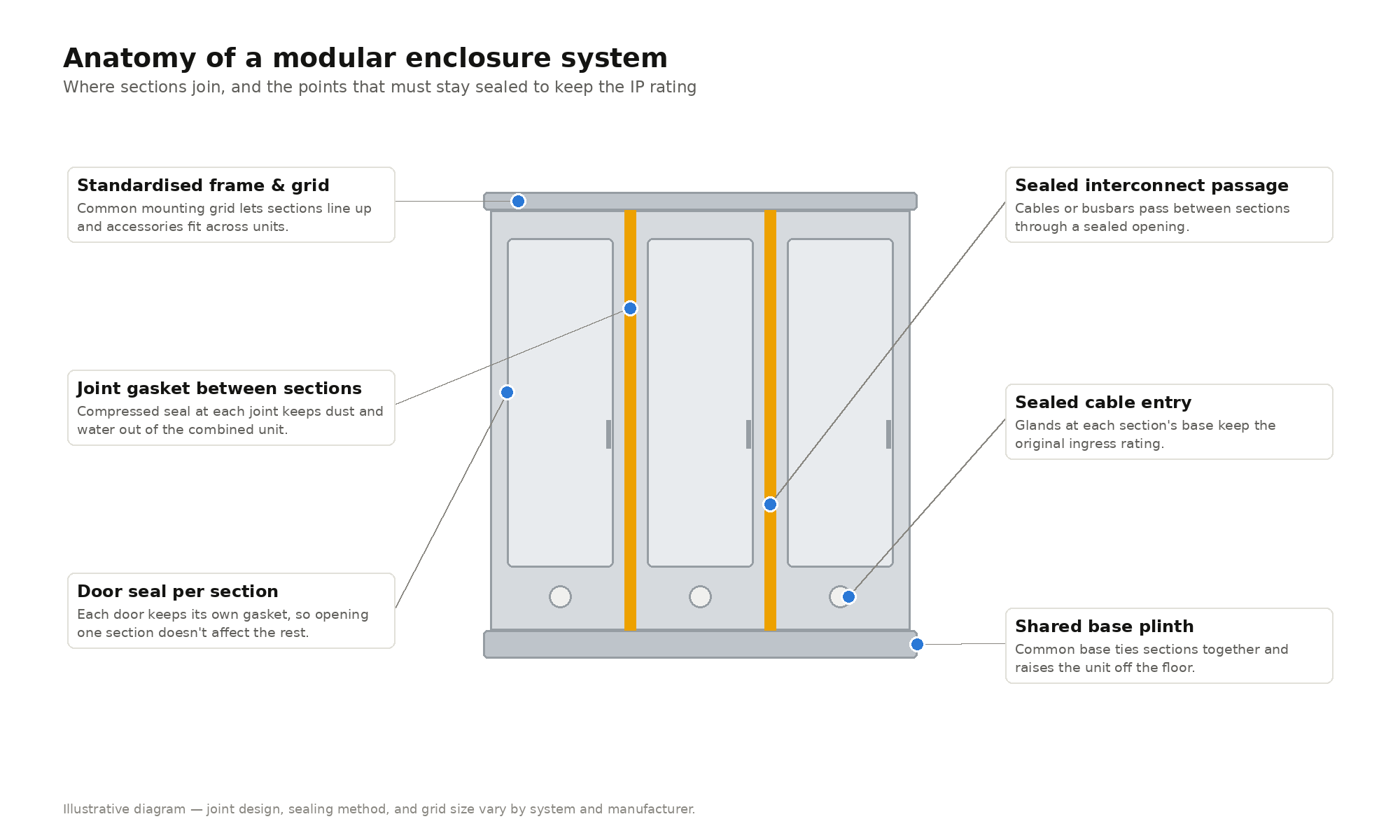
Fig 2: Anatomy of a modular enclosure system
None of these is a reason to avoid modular design. They are reasons to specify it carefully.
Is modular right for you? A decision checklist
Answer these questions honestly. If most are “yes”, modular is likely a good fit.
- Do you expect to add equipment or capacity within the next 3-5 years?
- Is shutdown time expensive or hard to schedule?
- Do you run multiple similar lines, panels, or sites?
- Would a consistent layout across installations save you time?
- Is your budget flexible enough to accept a higher initial cost for lower lifecycle cost?
If you answered “no” to most, and the load is fixed and unlikely to change, a well-built fixed enclosure may be the better value.
How to specify a modular system?
A few decisions made early will save a great deal of trouble later:
- Define the current load and likely expansion. Estimate where you will be in three to five years, even roughly.
- Set the required IP rating and material. Match both to the environment. Stainless steel suits corrosive or washdown sites, and mild steel with quality coating suits dry indoor areas.
- Confirm the section grid and joining method. Check how sections connect, how joints are sealed, and whether the system can be extended later on any side.
- Check certifications for the assembled system. Ask for test evidence on the joined unit, not just the individual section.
- Plan cable entry, ventilation, and access. Leave room for cable routes, heat dissipation, and service access in future sections.
Conclusion
Modular enclosure systems suit installations that are expected to grow or change, because you add to what you have instead of starting over. The benefits are real, but so are the trade-offs: a higher initial cost, more joints to keep sealed, and the need to plan the grid and expansion path early. Decide using the checklist above, specify the ratings for the assembled unit, and the system should reward you over its life.
To discuss your requirements, explore Bartakke’s electrical and automation enclosures, data center enclosures, and renewable energy enclosures, manufactured under ISO 9001:2015 with IP65/IP66-rated protection as standard.
Frequently Asked Questions
1. What industries benefit most from modular enclosures?
Industries that grow in stages or repeat the same layout benefit most: data centers, renewable energy, automation and manufacturing, water and wastewater, and machinery OEMs. The common factor is that capacity or layout changes over time.
2. Are modular enclosures more expensive than fixed designs?
Often, yes, at the point of purchase, especially for small installations. Over the life of an installation, they can cost less because sections are reused when the system grows or changes, and expansion needs less downtime and rework. The saving depends on whether you actually expand.
3. Can modular enclosures be expanded after installation?
Yes, that is their main purpose. Because sections connect on a common grid, new ones can be added alongside existing ones. Plan for this early, since it depends on leaving room next to the unit and on the joining method the system uses.
4. Do modular systems maintain the same IP/NEMA rating throughout?
They can, but only if the joints, door seals, and cable entries are designed and installed to preserve it. Every joint is a potential leak path, so ask the manufacturer for test evidence covering the assembled unit, and re-check the seals whenever sections are added.
5. Does Bartakke offer modular enclosure configurations?
Bartakke manufactures mild steel, stainless steel, and ATEX-certified enclosures, and works with customers on custom configurations. For the specific modular options available for your application, contact our engineering team with your layout and expansion plans.
6. Can modular enclosures be used in hazardous areas?
Yes, but the assembled system must be certified for the zone and gas group, not just the individual sections. Modular design does not change the certification requirement, so confirm it with the manufacturer before specifying.