

Bartakke Enclosures
An Industry 4.0 enclosure is a protective housing sized and built for dense, connected electronics, with attention to heat, cable routing and future expansion. Smart factories rely on these enclosures to protect the growing number of sensors, PLCs and communication devices that run automated lines, so enclosure reliability now affects uptime directly. As more connected devices are added to each line, specification shifts from simple protection to supporting cable density, heat loads and growth.
Key takeaways
- Enclosures in smart factories now house connected electronics, so they must manage heat, cabling and expansion, not just dust and water.
- Recheck the heat load first. Drives, power supplies and network switches concentrate heat in a small space.
- Plan spare capacity. A common rule of thumb is to leave 20–30% free space for added modules, though the right figure depends on your line.
- Keep power, signal and network cables separate from the start to reduce interference and rework.
- Match material and IP rating to the shop-floor environment, not to the highest number available.
How Industry 4.0 changes enclosure requirements?
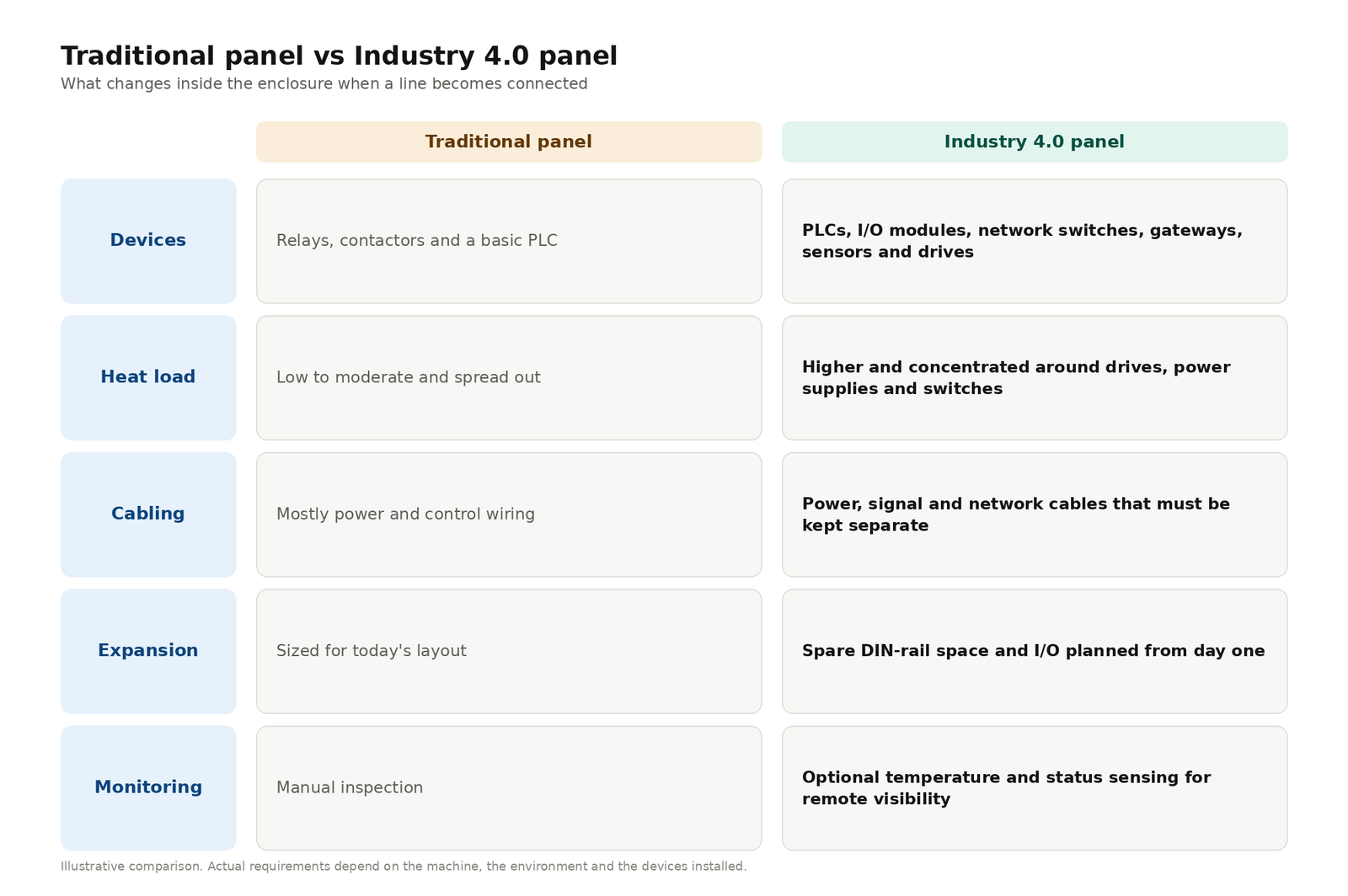
Industry 4.0 changes enclosure requirements by adding more devices, more cabling and more heat to each panel. A conventional panel switched motors and carried a basic controller. A connected panel also runs I/O modules, network switches and gateways that exchange data with other systems.
That shift changes what the enclosure must do. It still has to keep out dust, moisture and accidental contact, but it must also dissipate heat, keep cable types apart and leave room to grow. Fig 1 shows the main differences side by side.
In practice, three things change most:
- Device count. More modules per line means more mounting space and more wiring.
- Heat concentration. Heat gathers around drives, power supplies and switches rather than spreading evenly.
- Planning horizon. Panels are specified for where the line will be in a few years, not only for today.
What goes inside a smart factory enclosure?
A smart factory enclosure typically holds a PLC, I/O modules, an HMI or its interface, industrial Ethernet switches, a gateway, power supplies and sometimes variable frequency drives. Each device brings its own demands.
Device | Main enclosure implication |
PLC and I/O modules | DIN-rail space, spare slots, clean power |
Industrial Ethernet switch | Network cable routing, bend radius, heat |
Gateway or edge device | Ventilation, access for diagnostics |
Power supply | Heat output, clearance for airflow |
Variable frequency drive | Significant heat, possible electrical noise |
Sensors and field wiring | Cable entry, glands, segregation from power |
PLC panel design considerations
A good PLC panel design starts with the layout, not the box. Decide which devices go where, then choose an enclosure that fits the layout with room to spare.
Choose the right format. Wall-mount enclosures suit smaller PLC panels. Floor-mount or freestanding enclosures suit larger systems with drives and multiple sections. For complex lines, a compartmentalised design separates power from control. Our guide to compartmentalised electrical panels explains when that makes sense.
Segregate cables. Keep power cables away from signal and network cables. Where they must cross, cross them at right angles.
Plan earthing. Good earthing and a tidy mounting plate help reduce electrical noise that can disturb sensitive signals.
Follow the standards. Panel assemblies are generally designed against IEC 61439, and enclosure ingress protection is classified under IEC 60529. Confirm the requirements your project and customer specify.
Thermal management for dense electronics
Thermal management means removing the heat that components produce so the panel stays within the temperature limits on each device’s data sheet. Heat shortens component life and can cause intermittent faults, which are the hardest problems to trace on a production line.
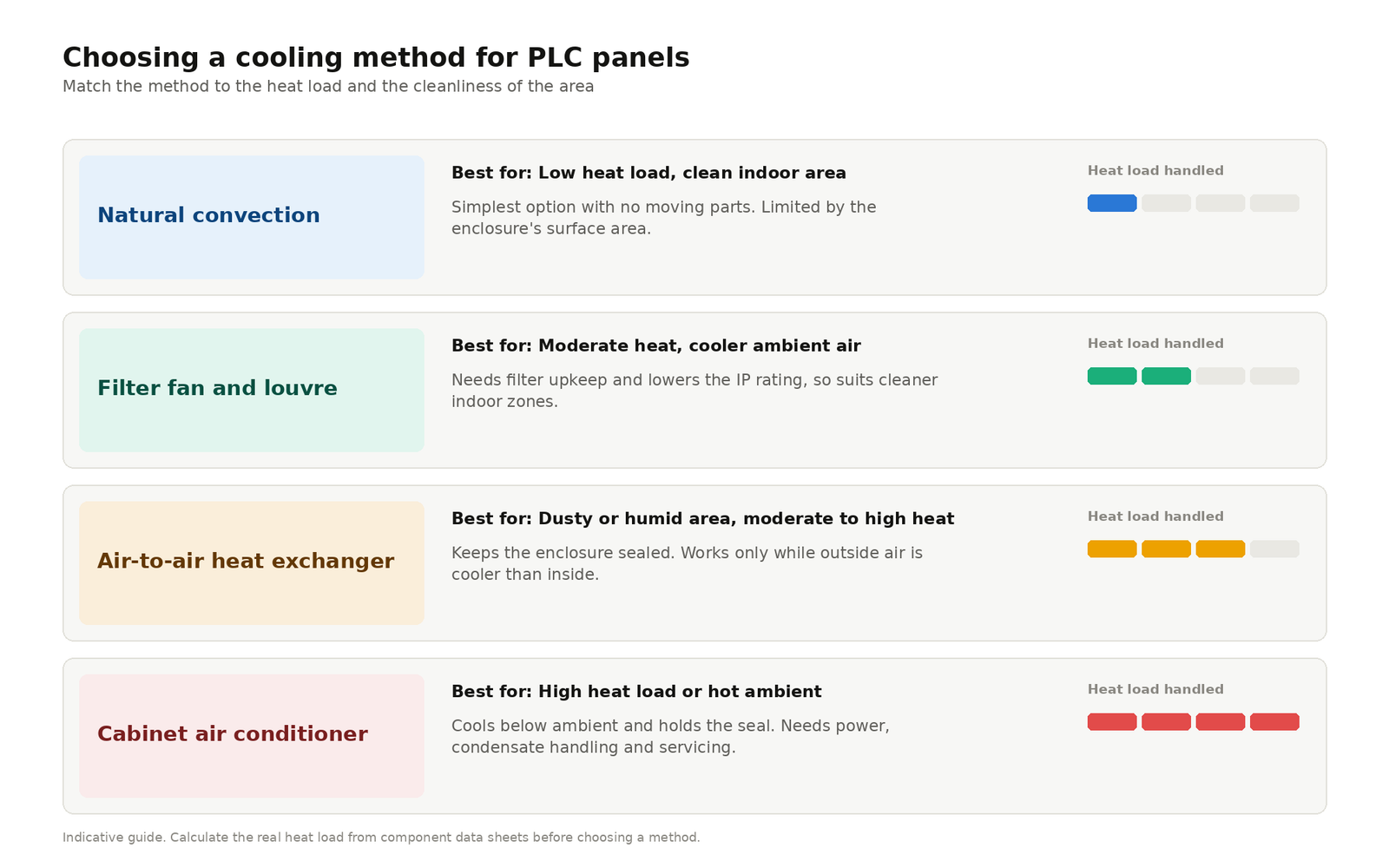
Start by adding up the heat output of the components using their data sheets. Then compare that with what the enclosure can shed naturally. If the panel would run too warm, choose a cooling method that fits the environment. Fig 2 summarises the options.
A few practical points:
- Natural convection is the simplest option and works for low heat loads in clean areas.
- Filter fans are economical but reduce the IP rating, so they suit cleaner indoor zones only.
- Heat exchangers and air conditioners keep the enclosure sealed, which matters in dusty or humid plants.
- Space components with care. Leave airflow gaps around power supplies and drives, and avoid mounting heat-sensitive modules directly above them.
Cable management and future-proofing
Cable management decides how easy a panel is to build, service and extend. Poor routing is a common cause of overheating, noise problems and slow fault-finding.
- Allow for cable bend radius, especially for network and fibre cables.
- Use trunking and clear routes, and label every cable.
- Place gland plates where cables will enter, and size them for additions.
- Leave spare DIN-rail length and spare I/O so a new sensor does not mean a new panel.
Future-proofing costs little at design stage and a lot afterwards. Adding a section to an undersized panel usually means downtime and rewiring.
Material, IP rating and environment
Match the enclosure to the area of the factory it will sit in. An assembly hall and a washdown or chemical zone need different choices.
Material | Best fit | Notes |
Powder-coated mild steel | Dry indoor factory floors | Economical and strong; coating quality matters |
Stainless steel SS304 | General industrial, light washdown | Good corrosion resistance |
Stainless steel SS316 | Coastal, chemical, food and pharma areas | Better resistance to chlorides |
Non-metallic (polyester/FRP) | Corrosive atmospheres | Naturally corrosion resistant |
For ingress protection, IP54 to IP55 often suits clean indoor areas, while IP65 or IP66 suits dusty, damp or washdown zones. Higher is not automatically better. Specify what the environment needs. For more on ratings and materials, see our guide to electrical and automation enclosures.
PLC panel enclosure specification checklist
Before you request a quote, confirm these points:
- Installation environment (indoor, outdoor, washdown, dusty, coastal)
- Required IP rating
- Total heat load from component data sheets
- Enclosure size with 20–30% spare space as a starting point
- Cable entry positions and quantities
- Material and finish
- Mounting format (wall, floor, freestanding)
- Required certifications and documentation
- Ventilation or cooling method
- Expected future expansion
When a standard enclosure is enough?
Not every panel needs a custom or heavily cooled solution. A small PLC panel with low heat output, installed in a clean, dry area, is often well served by a standard mild steel enclosure with natural ventilation.
Move to a custom design when the layout is dense, the heat load is high, the area is harsh, or you plan to extend the line. Paying for features you do not need adds cost without adding reliability.
Choosing a partner for automation enclosures
A good partner asks about your layout, environment and expansion plans before quoting. Look for ISO 9001:2015 manufacturing, clear documentation, willingness to build around your layout and honest lead-time estimates.
Bartakke manufactures enclosures for industrial and automation applications, including mild steel and stainless steel options. To discuss a PLC panel or automation project, explore our electrical and automation enclosures or contact the team with your layout and site details.
Frequently asked questions
How does Industry 4.0 change enclosure specifications?
Industry 4.0 adds more connected devices to each panel, so enclosures need more mounting space, better heat management and cleaner cable routing. Buyers should also plan spare capacity for future modules. The enclosure shifts from a simple protective box to part of the factory’s infrastructure.
What size enclosure is needed for a typical PLC panel?
There is no single size. Add up the footprint of the PLC, I/O modules, power supply, switches and any drives, then allow space for wiring, airflow and spare capacity. Many designers leave roughly 20–30% free as a starting point, adjusted for the project.
Do smart factory enclosures need active cooling?
Not always. Low heat loads in clean indoor areas can rely on natural convection. Panels with drives, power supplies and switches packed closely, or panels in hot or dusty areas, often need a fan, heat exchanger or air conditioner. Calculate the heat load first.
Can enclosures be designed around a specific automation layout?
Yes. Custom enclosures can be built around a given layout, including cut-outs, mounting plates, gland positions and ventilation. Share your component list, drawings and site conditions early, so the enclosure is sized and detailed correctly before fabrication begins.
What is the typical lead time for a custom PLC enclosure?
Lead time depends on design complexity, material, finish, quantity and whether drawings are approved. Standard sizes are generally quicker than fully custom builds. Ask your manufacturer for a quoted timeline against your specification rather than relying on a generic figure.
Which IP rating suits a factory floor?
IP54 or IP55 usually suits clean, dry indoor areas. IP65 or IP66 suits dusty, humid or washdown zones. Choose by the real conditions at the machine, because a higher rating adds cost without benefit where it is not needed.