

Bartakke Enclosures
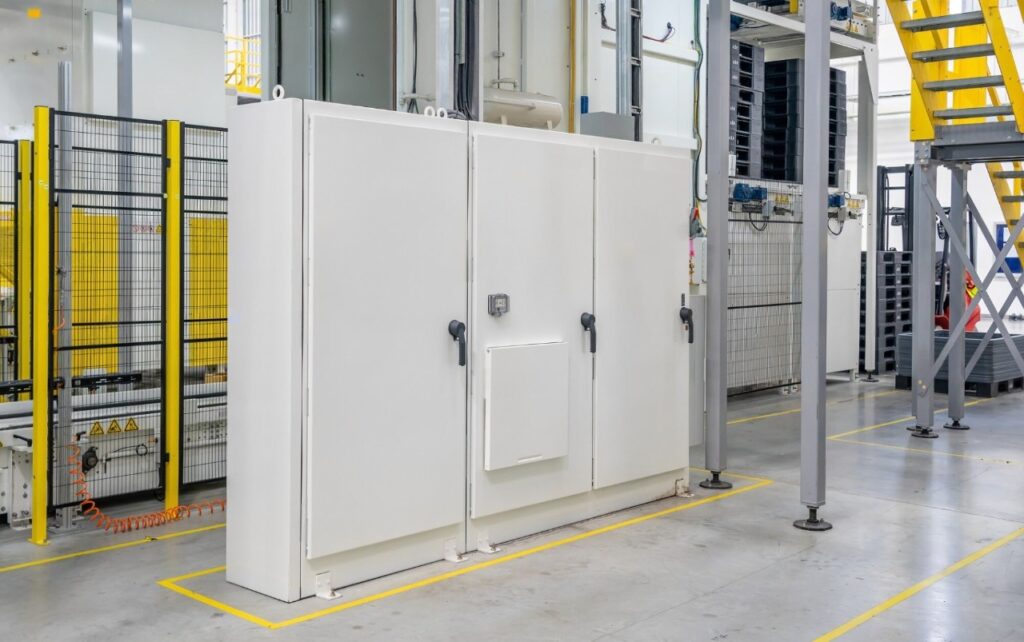
Biogas and Bio-CNG facilities are usually discussed in terms of sustainability – waste diverted from landfills, methane captured instead of released, farmers earning from organic manure. That story is accurate, but it is only half of it.
The other half is engineering. Every biogas and Bio-CNG plant handles methane and, in most feedstocks, hydrogen sulphide, throughout the process – from the digester to the upgrading unit to compression and storage. Both gases are flammable, and hydrogen sulphide is toxic even at low concentrations. That combination turns ordinary-looking industrial infrastructure into a classified hazardous area, and it means the electrical enclosures protecting instrumentation, controls, and field equipment cannot be an afterthought.
This guide covers why biogas plants are hazardous areas, how zone classification works, and what to look for in an ATEX-certified enclosure.
Why are biogas and Bio-CNG plants hazardous areas?
A biogas plant is not one hazard zone – it is several, layered across the process:
- Anaerobic digesters and covered lagoons, where methane accumulates continuously under the digester cover
- Feedstock reception and pretreatment, where hydrogen sulphide can be released during handling of manure, sewage sludge, or press mud
- Biogas upgrading (PSA / membrane / water scrubbing) units, where raw biogas is separated into methane and CO2 under pressure
- Compression and Bio-CNG storage, where methane is compressed to high pressure for dispensing or grid injection
- Flare stacks and pressure relief points, which vent combustible gas intermittently
Instrumentation, motor control centres, junction boxes, and field transmitters are typically installed close to all of these points, because that is where the process actually needs to be measured and controlled. That proximity is exactly why standard, non-rated enclosures are not suitable here.
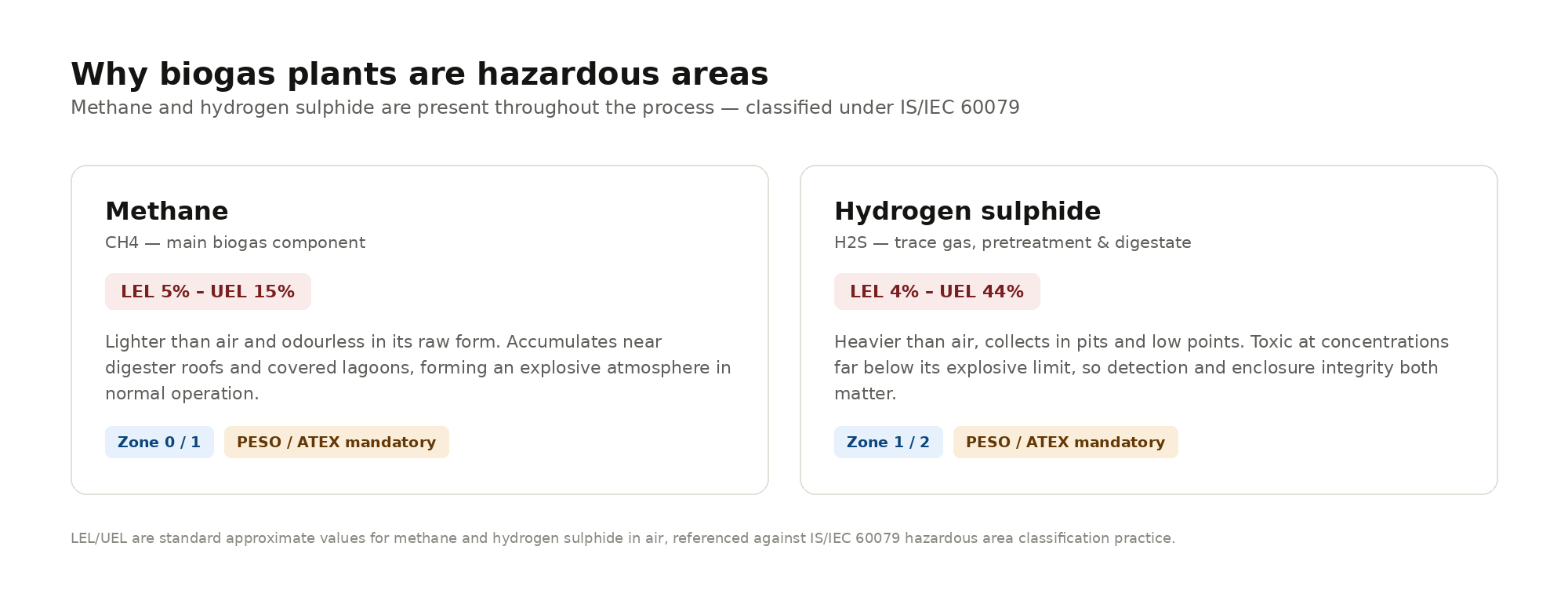
[Why biogas plants are hazardous areas: methane and hydrogen sulphide LEL/UEL and zone classification, to be placed in this section]
Understanding the gases: methane and hydrogen sulphide
Two gases drive the hazardous area classification in almost every biogas project:
Methane (CH4) is the primary combustible component of biogas, typically 50-70% of raw biogas by volume. It is lighter than air, so it rises and collects near digester roofs, gasholders, and enclosed headspace – areas where an explosive atmosphere can be present continuously or frequently during normal operation.
Hydrogen sulphide (H2S) is present in smaller concentrations but carries two risks at once: it is flammable, and it is highly toxic well below its flammable threshold. Unlike methane, H2S is heavier than air and settles in pits, sumps, and low-lying enclosures, which is why pretreatment and digestate handling areas need just as much attention as the digester itself.
Because both gases can be present under normal operating conditions rather than only during a fault or leak, most biogas plants end up with genuine Zone 0 or Zone 1 areas around the digester and upgrading unit, and Zone 2 areas extending into surrounding storage, compression, and pipeline corridors.
Hazardous area zone classification in biogas plants
Under IS/IEC 60079, hazardous areas are classified by how often and how long an explosive atmosphere is expected to be present:
- Zone 0 – an explosive atmosphere is present continuously or for long periods. Typically inside digesters, gasholders, and closed vessels.
- Zone 1 – an explosive atmosphere is likely to occur in normal operation. Around digester covers, feed pits, and upgrading skids.
- Zone 2 – an explosive atmosphere is not likely in normal operation, and if it occurs, only briefly. Surrounding storage, compression rooms, and pipeline routes.
This classification directly determines what equipment can go where. Zone 0 and Zone 1 areas require Ex-marked, ATEX or PESO-certified equipment rated for that specific zone and gas group. Zone 2 areas allow more flexibility, including standard control equipment housed inside a certified enclosure – such as a purged and pressurised enclosure – that keeps the hazardous atmosphere out entirely.
What makes an enclosure ATEX-certified?
An ATEX-certified enclosure is built and tested to prevent it from becoming an ignition source in a classified zone.
That comes down to a few core design principles:
- Flameproof (Ex d) construction – the enclosure can contain an internal explosion without transmitting it to the surrounding atmosphere, with tightly toleranced joint gaps and flame paths
- Increased safety (Ex e) – eliminates arcs, sparks, and hot surfaces in normal operation through enhanced insulation, clearances, and terminal design
- Certified ingress protection – typically IP65 or IP66, so dust, moisture, and corrosive vapours from digestate and pretreatment areas cannot compromise internal components
- Gas group and temperature class rating – matched to the specific gas present (methane sits in gas group IIA; hydrogen sulphide applications are usually specified to IIB for a wider safety margin)
- Material and coating resistance – biogas environments are corrosive, so stainless steel or high-grade powder-coated mild steel construction matters as much as the Ex rating itself
For control panels, PLCs, and instrumentation that don’t need to sit inside a Zone 0 or Zone 1 area but do need to operate near one, a purged and pressurised enclosure is often the more practical route – standard electronics inside, with clean air maintained at positive pressure so the hazardous atmosphere physically cannot enter.
India’s Bio-CNG growth is accelerating – and so is the engineering gap
Government support for compressed biogas has moved from pilot-stage to national scale. The GOBARdhan scheme has been approved with an outlay of ₹23,731 crore, targeting close to a ten-fold increase in domestic CBG production between FY 2026-27 and FY 2035-36. Mandatory CBG blending in CNG and PNG networks is being phased in as well, rising to 5% from FY 2028-29.
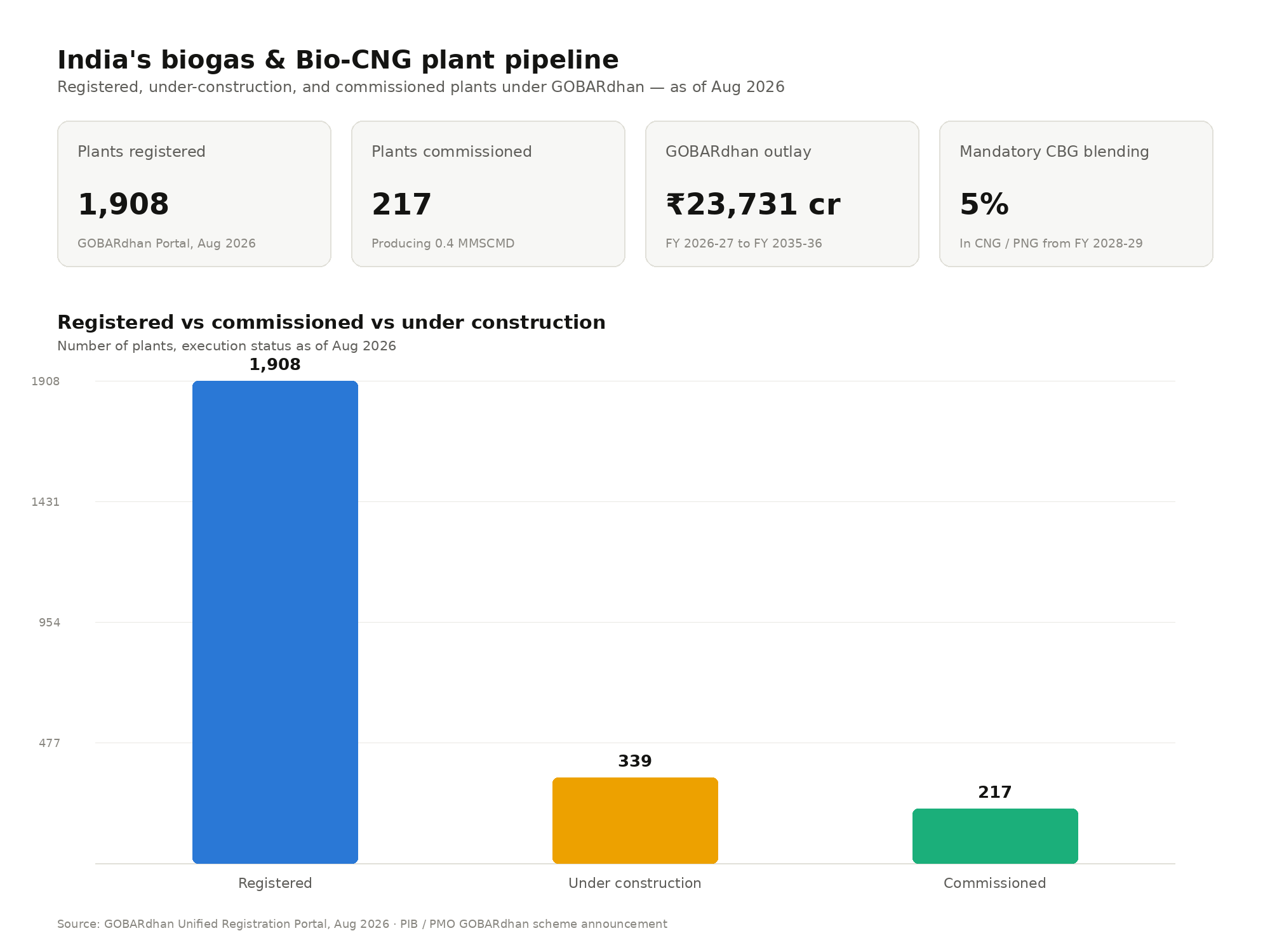
[India’s bio-CNG and CBG plant pipeline: registered vs commissioned vs under-construction plants, to be placed in this section]
As of August 2026, 1,908 plants have been registered on the GOBARdhan portal, with 217 already commissioned and 339 under construction. That gap between registration and commissioning is where most of the current build-out activity sits – and it’s exactly the stage at which hazardous area classification, equipment selection, and enclosure specification get decided. Plants being designed and built today will set the standard the rest of the sector follows.
Where ATEX enclosures are used in a biogas or Bio-CNG plant?
In a typical facility, ATEX and purged enclosures show up at several points along the process:
- Digester-area instrumentation (level, pressure, and gas composition sensors)
- Junction boxes and cable termination points near feed and pretreatment zones
- Motor control centres for agitators, pumps, and compressors
- Biogas upgrading unit control panels (PSA, membrane, or scrubbing systems)
- Bio-CNG compression and dispensing station electricals
- Flare and pressure relief system controls
Each of these locations may fall under a different zone, which is why enclosure selection needs to be done area-by-area rather than applied as a single blanket specification across the plant.
Choosing the right ATEX enclosure partner
Selecting an ATEX enclosure isn’t just about the certificate – it’s about whether the manufacturer understands zone classification, gas group requirements, and the corrosive, high-humidity conditions typical of biogas and Bio-CNG sites. Bartakke’s ATEX-certified explosion-proof enclosures are built for exactly this kind of demanding hazardous-area application, combining IP65/IP66 ingress protection with construction suited to Zone 1 and Zone 2 environments across energy, process, and industrial sites.
As India’s renewable gas infrastructure scales up, the plants that get hazardous area engineering right from day one will be the ones that scale safely alongside it.
Frequently asked questions
1. Are all areas of a biogas plant classified as hazardous?
No. Classification is area-specific. Digesters, gasholders, and upgrading units are typically Zone 0 or Zone 1, while surrounding storage and compression areas are often Zone 2. A hazardous area study is needed to map each zone individually rather than assuming the whole plant is uniformly rated.
2. What’s the difference between an ATEX-rated enclosure and a purged enclosure?
An ATEX-rated (Ex d / Ex e) enclosure is built to contain or prevent ignition sources and can be installed directly inside a classified zone. A purged and pressurised enclosure instead keeps standard, non-rated electronics safe by maintaining clean, pressurised air inside so the hazardous atmosphere can’t enter – commonly used for PLCs and HMIs in Zone 2 areas.
3. Why is hydrogen sulphide a bigger concern than methane in some biogas plants?
H2S is toxic to humans at concentrations well below its flammable limit, and it settles in low-lying areas like pits and sumps rather than dispersing upward like methane. This means H2S-prone areas often need both gas detection and hazardous-area rated equipment, not just ventilation.
4. Do Bio-CNG compression and storage areas need ATEX enclosures too?
Yes. Compression brings methane to high pressure, and any leak at fittings, valves, or seals can create a Zone 2 (and sometimes Zone 1) atmosphere around the compression skid. Control panels and instrumentation in this area should be selected to match the zone classification, not treated as a lower-risk zone by default.
5. What IP rating should ATEX enclosures for biogas plants have, in addition to the Ex rating?
IP65 or IP66 is standard for biogas applications, given the moisture, dust, and corrosive gas exposure typical of digestate handling and pretreatment areas. The Ex rating addresses ignition risk; the IP rating addresses environmental ingress – both are needed together.
6. Is ATEX certification mandatory for biogas plants in India, or is PESO certification sufficient?
In India, hazardous area equipment is regulated by PESO (Petroleum and Explosives Safety Organization), and PESO certification is the applicable statutory requirement. ATEX is the European framework but shares the same underlying IS/IEC 60079 principles, so many manufacturers design to meet both standards, which is useful for plants that also export equipment or work with international EPC contractors.