

Bartakke Enclosures
Solar and wind installations expose enclosures to prolonged UV, temperature swings, wind-driven rain and, in many regions, dust or salt air. A weatherproof renewable-energy enclosure is a sealed, corrosion- and UV-resistant housing that protects inverters, combiner boxes and SCADA panels outdoors, typically at IP65 or IP66. As renewable capacity grows, enclosure specification is one of the most overlooked reliability factors in plant design.
Key takeaways
- Specify enclosures per component. An inverter, a combiner box and a SCADA panel face different heat and exposure.
- IP65 or IP66 is the usual outdoor starting point, adjusted for the site.
- Material decides service life. UV, humidity and salt matter as much as the IP rating.
- Sealed versus ventilated is a trade-off between getting heat out and keeping dust, water and salt out.
- Under-specifying costs more than over-specifying, because failures happen in the field.
Environmental stresses on solar and wind sites
Outdoor renewable plants stress enclosures through UV radiation, temperature cycling, driven rain, dust, humidity and, near the coast, salt. Each attacks a different part of the enclosure, so one site can need several defences at once. Fig 1 maps each stress to its effect and the usual design response.
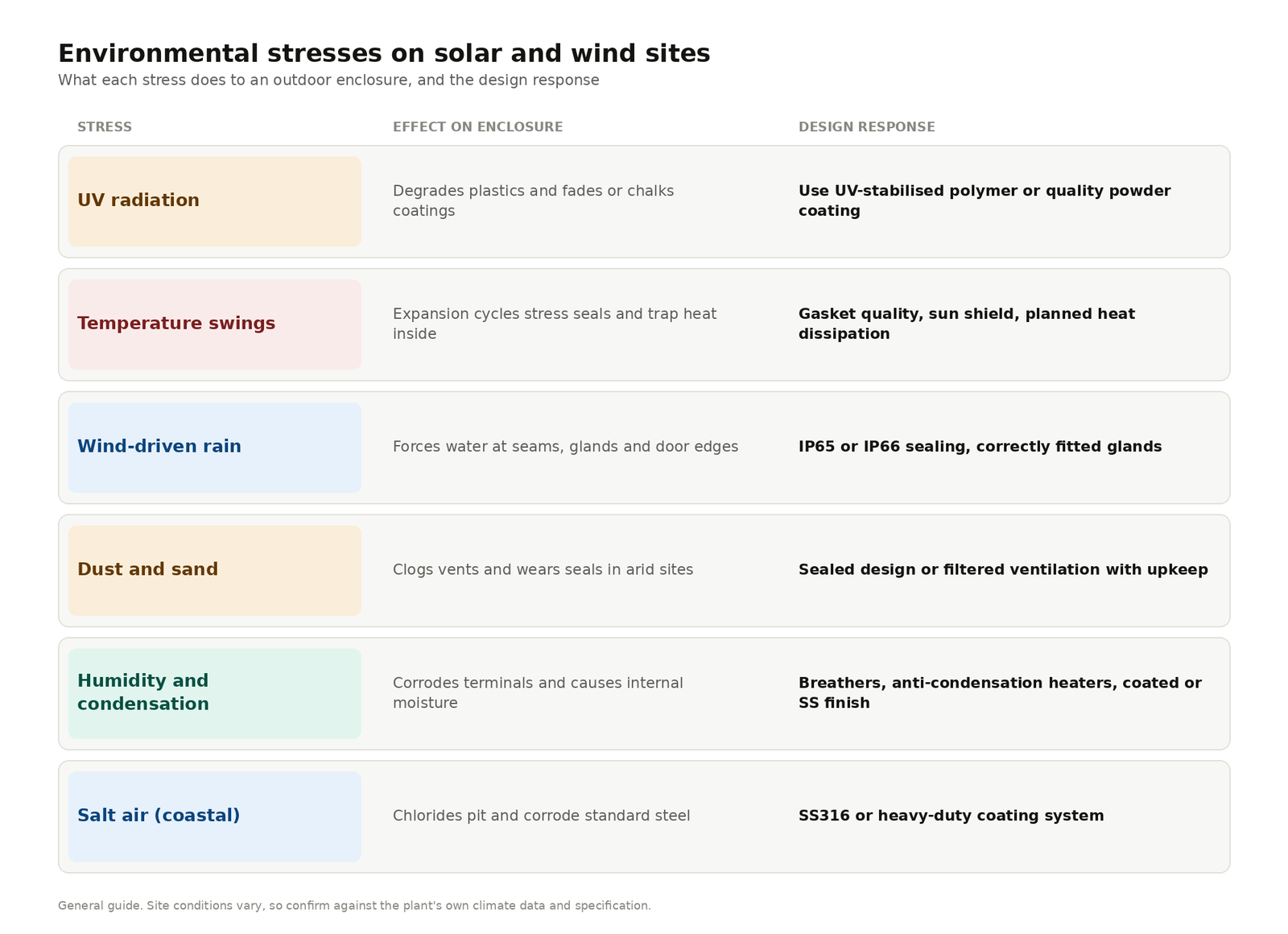
Three points are worth stressing for Indian conditions:
- Heat and sun load. A box in direct sun can run well above ambient before its contents add any heat.
- Monsoon and humidity. Rain at seams and glands, plus condensation inside, are common failure points.
- Dust and coastal air. Arid sites clog vents. Coastal sites corrode standard steel quickly.
What a weatherproof enclosure must do?
A weatherproof enclosure must keep water and dust out, resist UV and corrosion, and let heat escape, all for the plant’s working life. Ingress protection is classified under IEC 60529. In outdoor plants, IP65 (dust-tight, protected against water jets) and IP66 (dust-tight, protected against powerful water jets) are the common choices. IP67 or higher is for temporary immersion and is rarely needed above ground. A higher number is not automatically better. It is only useful where it matches the real exposure.
Inverter and combiner box enclosure requirements
Combiner boxes gather string wiring and are often mounted on frames in full sun. They need solid sealing at every cable entry, UV-stable materials and a finish that tolerates years of heat and rain.
Inverter housings are different because inverters give off heat. The enclosure must protect against the weather while letting that heat out. That makes design choices around sun shields, spacing and cooling more important than for a passive junction box.
SCADA and communication panels hold sensitive electronics. They need a clean, dry interior, stable temperature and good cable management so signals stay reliable.
Component-to-specification guide
Use this table as a starting point and confirm it against your project specification.
Component | Typical rating | Material starting point | Key consideration |
DC combiner box | IP65–IP66 | Powder-coated steel, SS304 or UV-stable polymer | Sun load, sealed cable glands |
Inverter housing | IP65–IP66 | Coated steel or stainless steel | Heat dissipation and sun shielding |
SCADA / communication panel | IP65 | Coated steel or stainless steel | Clean interior, stable temperature |
Wind turbine base controls | IP65–IP66 | Coated steel or SS316 | Vibration, humidity |
Outdoor junction box | IP65–IP66 | Coated steel, SS or polymer | Cable entry and UV |
Coastal site (any component) | IP66 | SS316 | Chloride corrosion |
Material choice for UV and outdoor exposure
Material choice sets how well an enclosure survives UV, humidity and salt. No material suits every site.
Material | Strengths | Watch for |
Powder-coated mild steel | Strong and economical | Coating quality; damaged edges expose bare steel |
Stainless steel SS304 | Good general corrosion resistance | Chlorides can cause pitting at the coast |
Stainless steel SS316 | Resists chlorides and salt air | Higher cost |
Polycarbonate / FRP | Corrosion resistant and light | UV stabilisation and impact strength |
For most inland plants, well-coated steel or SS304 is a sound choice. For coastal plants, SS316 is the safer one. Non-metallic enclosures suit smaller boxes where corrosion is the main risk, provided they are UV-stabilised.
Ventilation versus sealed design trade-offs
A sealed enclosure keeps dust, water and salt out but traps heat. A ventilated enclosure moves heat out but lets in whatever is in the air. Fig 2 summarises when each makes sense.
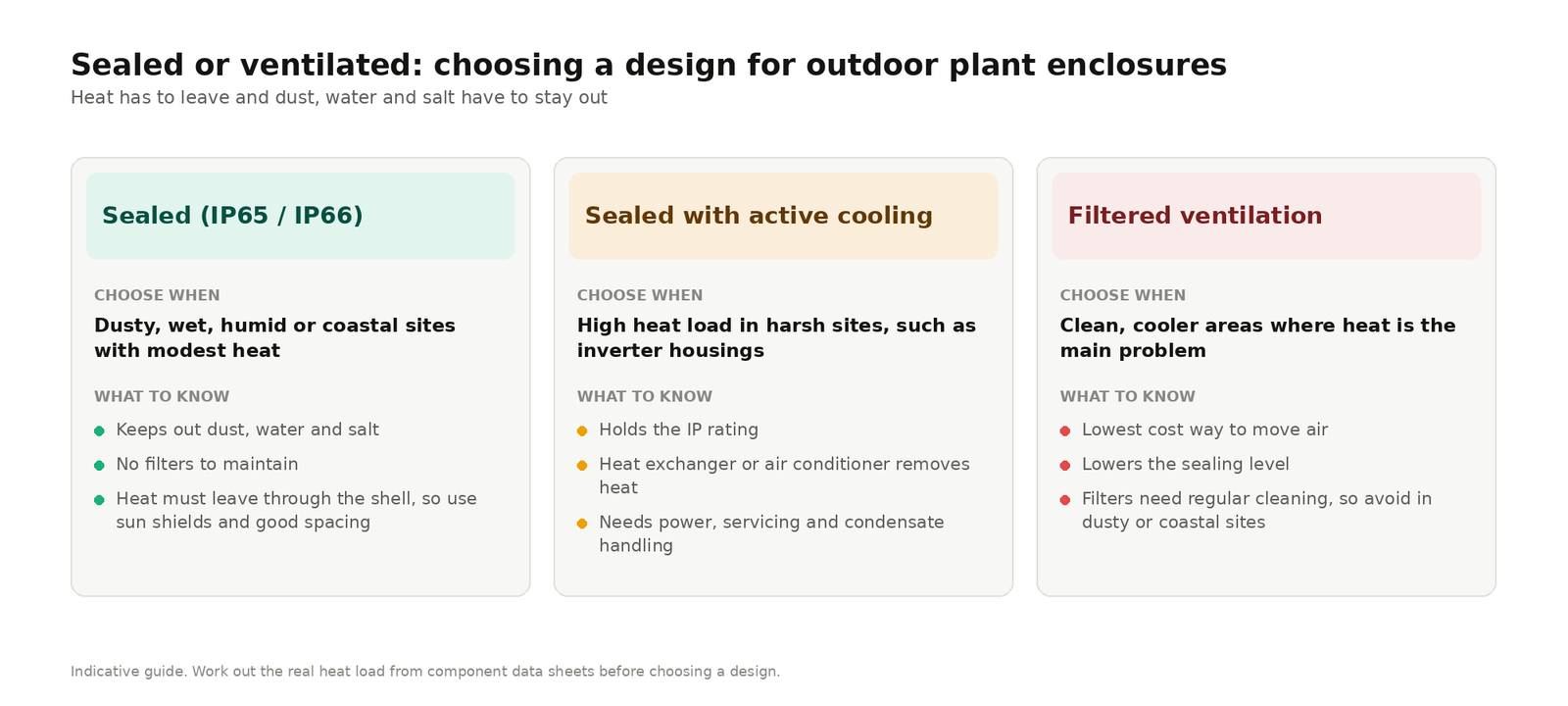
In short:
- Sealed with passive heat shedding suits dusty, wet or coastal sites with modest heat.
- Sealed with active cooling (heat exchanger or air conditioner) suits high heat loads in harsh sites, at the cost of power use and servicing.
- Filtered ventilation suits clean, cooler areas. Filters must be cleaned or they stop working.
Sun shields and double-skin roofs help every option by cutting solar heat gain before it reaches the box.
Wind farm specifics
Wind sites add vibration, remote locations and high humidity inside towers. Controls at the tower base need sealing against moisture and fixings that tolerate vibration. Because wind sites are often remote, maintenance access is costly, so choose a robust finish that does not need frequent attention.
Illustrative example
This is a hypothetical scenario, not a client project. Imagine a ground-mounted solar plant in a hot, dusty region. Combiner boxes sit on frames in full sun, string inverters are mounted in open bays, and a SCADA panel is housed in a small shelter. A sensible specification would be IP65 or IP66 combiner boxes in coated steel with UV-stable seals, sealed inverter housings with sun shields and spacing for heat, and an IP65 SCADA panel in a shaded location. Dust would rule out open vents.
Specification checklist
Before ordering, confirm:
- Component and installation point
- Site climate: heat, rain, dust, salt
- Required IP rating
- Material and finish
- Heat load and cooling approach
- Cable entry positions and glands
- Sun shielding or canopy
- Mounting method and wind loading
- Certification and documentation
- Maintenance access
When a standard outdoor box is enough?
A small, low-heat junction box in a mild, sheltered location often works well with a standard coated steel enclosure. Move to a custom or specially cooled design when heat load is high, the environment is harsh, or access for repair is difficult.
Choosing an enclosure partner!
Look for ISO 9001:2015 manufacturing, clear documentation and a willingness to design around your component list and site. Bartakke manufactures outdoor enclosures for energy and industrial applications. See our renewable energy enclosures and, for plants paired with batteries, our energy storage enclosures, or send your component list and site details for a recommendation.
Frequently asked questions
What IP rating is needed for outdoor solar inverter enclosures?
IP65 or IP66 is the usual choice for outdoor inverter enclosures. IP65 protects against dust and water jets. IP66 adds protection against powerful jets, which suits driven rain and washdown. Match the rating to the site, and remember that inverters also need a way to shed heat.
How does UV exposure affect enclosure material selection?
UV breaks down unprotected plastics and dulls coatings over time. For plastic enclosures, choose UV-stabilised material. For steel, choose a quality powder coating. Stainless steel is not affected by UV in the same way, which is why it is popular for long-life outdoor installations.
Should wind farm enclosures use active or passive cooling?
It depends on heat load and site conditions. Low heat loads can rely on passive cooling through the enclosure shell. Higher loads, such as drives in a tower base, may need active cooling. Keep the enclosure sealed where moisture or dust is present.
Can Bartakke supply enclosures for utility-scale solar projects?
Bartakke makes mild steel and stainless steel enclosures built to IP65 and IP66 for industrial and energy use. For utility-scale projects, share your quantities, component list and site conditions so the team can confirm design, volumes and timelines.
What is the expected lifespan of an outdoor renewable-energy enclosure?
Lifespan depends on the material, coating or finish, seal quality and site conditions, so no single figure applies. Coastal and high-UV sites wear enclosures faster. Ask the manufacturer for salt-spray or coating test data, and plan inspections of gaskets and finishes.
Do coastal solar plants need stainless steel enclosures?
Usually yes. Salt air attacks standard coated steel and can pit SS304, so SS316 is the safer choice near the coast. Where cost is a concern, a heavy-duty coating system may be acceptable, but confirm it against the site’s exposure.