

Bartakke Enclosures
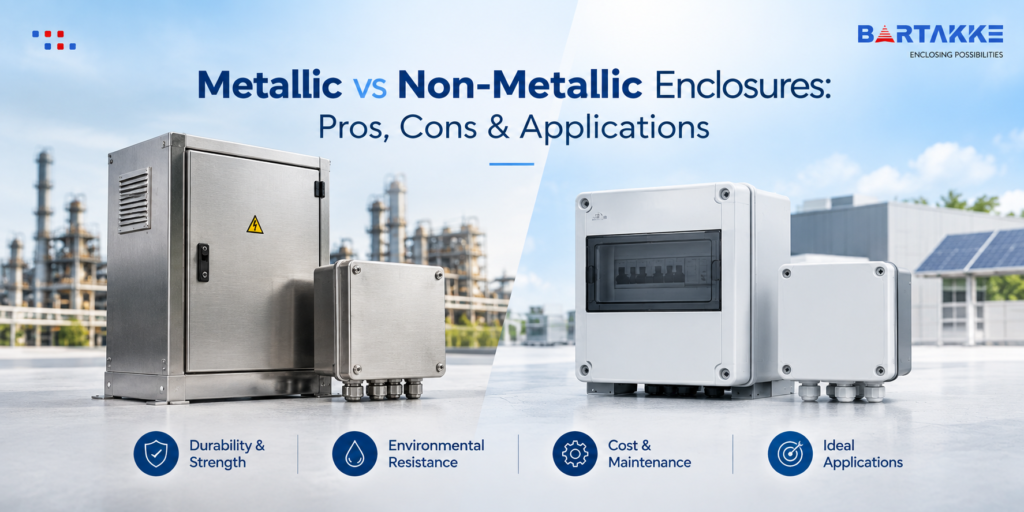
Hygienic enclosure design in food and beverage plants relies on crevice-free welds, sloped tops, IP66/IP69K sealing, and food-grade stainless steel to prevent bacteria buildup and withstand frequent washdowns. Poorly designed enclosures create hidden ledges where residue collects – a direct food-safety and audit risk under HACCP and FSSAI guidelines.
Key takeaways
- Hygienic enclosure design eliminates crevices, ledges, and dead spaces where bacteria and residue accumulate.
- Sloped tops (typically 30°+), rounded corners, and internal hinges/fasteners are the core physical design markers.
- IP66 handles general washdown; IP69K is required for high-pressure, high-temperature cleaning cycles.
- Food-grade 316 stainless steel resists both organic acid corrosion and aggressive detergent/disinfectant exposure.
- Poor enclosure hygiene is a direct HACCP and FSSAI audit risk, not just a maintenance issue.
Why hygiene matters in enclosure design?
Food and beverage production floors go through constant washdown cycles, and any electrical enclosure sitting on that floor becomes part of the hygiene equation whether it’s designed for it or not. Standard enclosures – flat tops, external screws, welded-on hinges – create exactly the conditions bacteria need: flat surfaces where water pools, gaps where residue lodges, and corners that a cleaning crew’s cloth or spray simply can’t reach.
Several factors accelerate this risk in food plants specifically:
- Detergents and disinfectants used in daily cleaning can degrade poorly protected surfaces over time
- Organic acids from food residue (lactic acid, acetic acid) are mildly corrosive to untreated metal
- Condensation from steam and washdown cycles collects inside poorly sealed enclosures
- Temperature swings between processing and cleaning cycles worsen condensation buildup
An enclosure that traps any of this becomes a hidden contamination source – invisible during a quick visual check, but exactly what an HACCP audit or swab test is designed to catch.
Key design features of a hygienic enclosure
A genuinely hygienic enclosure is built differently from a standard stainless steel box, not just made from a nicer grade of metal. The core features are:
- Sloped or pitched tops – angled at 30° or more so liquid runs off instead of pooling
- No exposed external fasteners – hinges and screws mounted internally, leaving a smooth, cleanable exterior
- Smooth, continuous welds – ground flush, with no gaps or crevices along any seam
- Rounded corners and seamless transitions – eliminating the 90° internal corners where residue collects
- FDA-compliant, chemical-resistant gaskets and seals – able to withstand repeated washdown without degrading
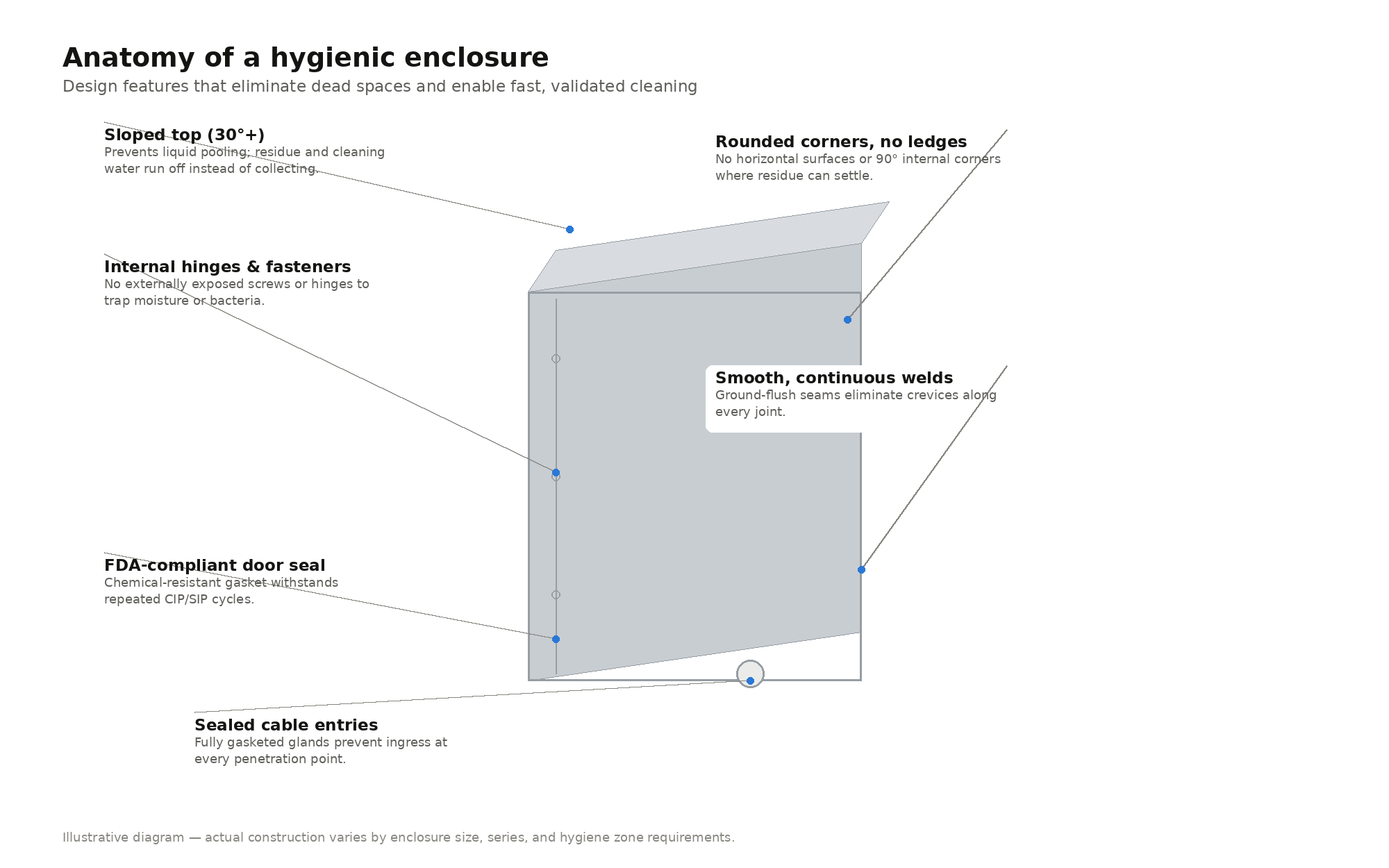
Fig 1 – Anatomy of a hygienic enclosure
IP66 vs IP69K – which washdown rating do you need?
Not every food-plant enclosure needs the same level of ingress protection, and getting this wrong in either direction causes problems – too low a rating risks water ingress, too high adds unnecessary cost.
Rating | Protects against | Typical use |
IP66 | Powerful water jets, general washdown | Standard production floor washdown |
IP69K | High-pressure, high-temperature steam-jet cleaning | Dairy, meat, and high-hygiene CIP/SIP zones |
IP69K specifically tests against close-range, high-pressure, high-temperature spray – the exact conditions used in dairy and meat processing sanitation cycles. If your plant uses steam cleaning or high-pressure hot-water washdown at close range, IP66 alone isn’t sufficient.
Material selection – why 316 stainless steel
Stainless steel is the default material for food-contact-adjacent enclosures, but 304 and 316 grades perform very differently under sustained chemical exposure.
SS304 offers good general corrosion resistance and works well in lower-exposure areas of a plant. SS316 adds molybdenum to the alloy, which specifically improves resistance to chlorides and the acidic, chemical-heavy conditions typical of daily detergent and disinfectant use. For any enclosure in direct or near-direct contact with cleaning chemicals, condensation, or organic acid exposure – which describes most production-floor locations – SS316 is the safer long-term choice, even though it carries a higher upfront cost than SS304.
Compliance considerations – HACCP and FSSAI
Hygienic enclosure design isn’t just good engineering practice – it directly supports two compliance frameworks Indian food and beverage manufacturers are already required to work within.
HACCP (Hazard Analysis and Critical Control Point) treats equipment design as part of hazard control, not just food handling steps. An enclosure with dead spaces or unsealed gaps is a legitimate microbiological risk point in an HACCP plan, not a minor maintenance detail.
FSSAI (Food Safety and Standards Authority of India) guidelines for food manufacturing facilities expect equipment and fixtures – enclosures included – to support, not undermine, the plant’s overall hygiene standards during inspection and audit. An enclosure that can’t be fully cleaned or inspected without disassembly is a point an FSSAI auditor is trained to flag.
Getting enclosure design right from the specification stage avoids retrofit costs later and keeps hygiene documentation straightforward during audits.
Auditor’s hygienic enclosure checklist
Use this as a quick pre-audit or procurement checklist:
- Sloped top, no flat horizontal surfaces
- No externally exposed fasteners or hinges
- Continuous, ground-smooth welds with no visible seams
- IP66/IP69K-rated seals, undamaged and pliable
- No visible corrosion, pitting, or discoloration
- Cable entries fully sealed, with no gaps
- Accessible for visual inspection without disassembly
Case Example
Consider a bottling line control panel mounted near a CIP (clean-in-place) washdown station. With a standard stainless enclosure – flat top, external hinges – cleaning crews had to manually wipe down pooled water and residue after every shift, and a routine hygiene audit flagged visible residue buildup around the hinge points as a non-conformance.
Switching to a hygienic-design enclosure with a sloped top and internally mounted hinges removed the pooling issue entirely – washdown water now runs off automatically, cleaning time dropped, and the same audit point passed cleanly on the next inspection cycle. The enclosure itself didn’t change what it protected; it changed how much manual intervention and audit risk sat around it.
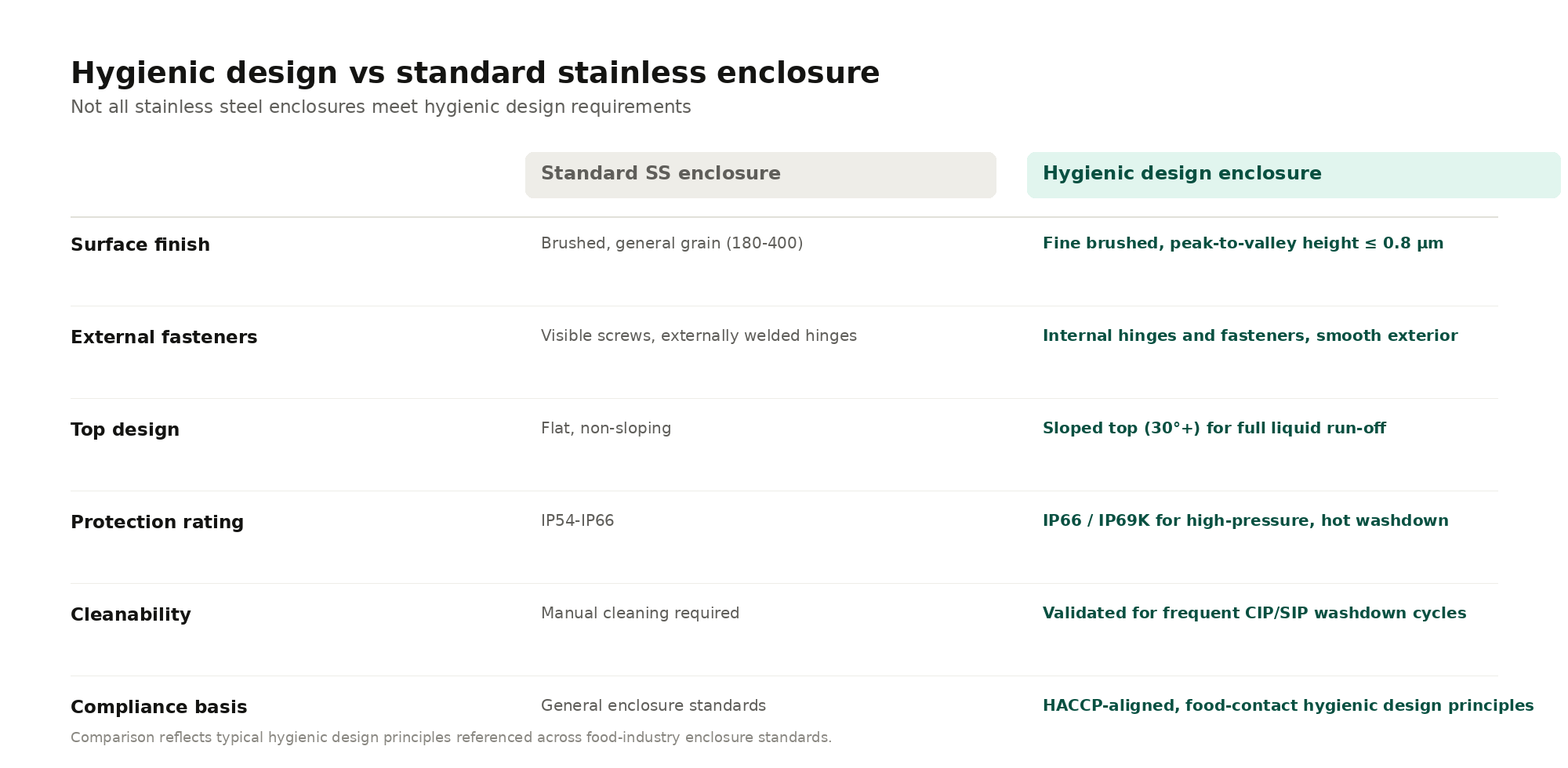
Fig 2 – Hygienic design vs standard stainless enclosure
Conclusion
Hygienic enclosure design isn’t a cosmetic upgrade over standard stainless steel – it directly affects cleaning time, corrosion risk, and audit outcomes in food and beverage plants. Getting the design features, IP rating, and material grade right at the specification stage is far cheaper than retrofitting after an inspection flags a problem.
Frequently Asked Questions
1. What IP rating is needed for washdown areas in food plants?
IP66 is the standard baseline for general production-floor washdown. Areas using high-pressure, high-temperature steam cleaning – common in dairy and meat processing – need IP69K, which is specifically tested against close-range, high-temperature spray.
2. Why do food-grade enclosures use sloped tops?
A sloped top, typically 30° or more, ensures water and residue run off completely instead of pooling on a flat surface. Flat tops are one of the most common sources of hidden contamination in food-plant enclosures.
3. Is 304 or 316 stainless steel better for food processing?
SS316 is generally the better choice for food processing environments because its molybdenum content improves resistance to chlorides and the acidic, chemical-heavy exposure typical of daily cleaning cycles. SS304 is suitable for lower-exposure areas where budget is a bigger constraint.
4. How often should hygienic enclosures be inspected?
Inspection frequency should align with the plant’s existing HACCP schedule – typically as part of routine hygiene audits and cleaning validation checks. Enclosures in high-washdown zones (CIP/SIP areas) warrant more frequent visual inspection for seal integrity and corrosion.
5. Does Bartakke offer IP69K-rated enclosures?
Bartakke manufactures IP65/IP66-rated stainless steel enclosures as standard, with hygienic design features and higher protection ratings available for food and beverage applications on request – reach out to our engineering team to specify IP69K requirements for your project.
6. What makes an enclosure “HACCP-compliant” if there’s no formal HACCP certification for equipment?
There’s no standalone HACCP certificate for enclosures – HACCP is a food-safety management system, not a product standard. An enclosure supports HACCP compliance by eliminating the design features (dead spaces, unsealed gaps, hard-to-clean corners) that would otherwise represent a hazard point in the plant’s HACCP plan.
Explore Bartakke’s enclosures built for food & beverage industry environments and stainless steel enclosures (encloINOX), manufactured under ISO 9001:2015 with IP65/IP66-rated protection as standard.