

Bartakke Enclosures
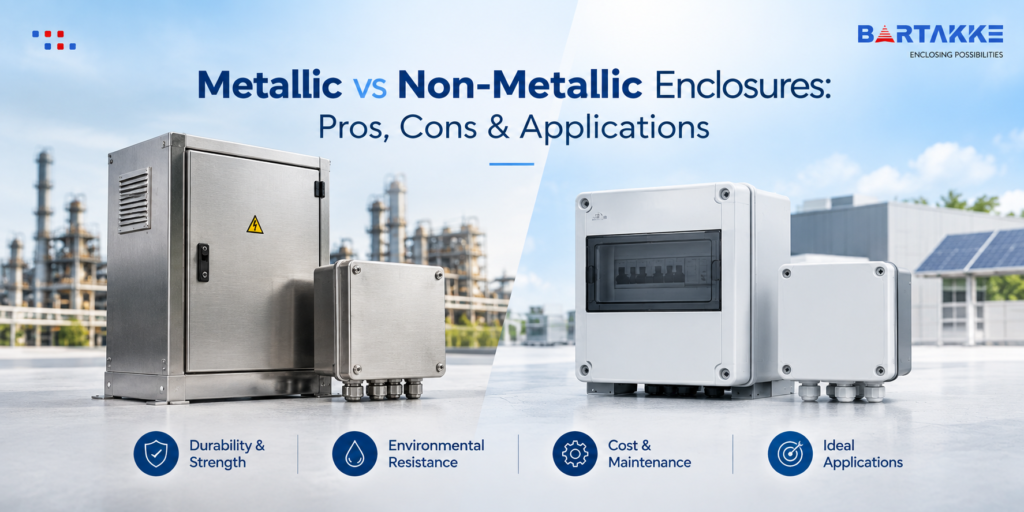
Metallic enclosures (mild steel, stainless steel, aluminum) offer strength, EMI shielding, and long service life, while non-metallic enclosures (fiberglass, polycarbonate) resist corrosion, weigh less, and cost less upfront in mild environments. Non-metallic types now account for a growing share of the global market, especially in food & beverage and telecom applications where corrosion resistance and hygiene matter more than raw strength.
Key takeaways
- Metallic enclosures win on strength, EMI shielding, and impact resistance; non-metallic wins on corrosion resistance, weight, and wireless compatibility.
- Non-metallic share is growing to roughly 35-39% of the global enclosure market, driven by food & beverage and telecom demand.
- The cheaper material upfront isn’t always cheaper over a 10-year service life – corrosion and coating failure drive real cost.
- EMI shielding only matters in specific applications (telecom, control rooms near VFDs) – it’s not a factor for most general industrial use.
- Material choice should follow the environment first, budget second – not the reverse.
How do metallic enclosures perform?
Metallic enclosures are built from mild steel, stainless steel (SS304/SS316), or aluminum, and remain the default choice across heavy industrial and EMI-sensitive applications.
Strengths:
- High strength and impact resistance – holds up to physical damage and rough handling
- Natural EMI/RFI shielding, useful near VFDs, motors, and sensitive control systems
- Long service life when properly coated and maintained
Weaknesses:
- Corrosion risk if the coating is under-specified or damaged, especially with mild steel
- Heavier, which adds to shipping and installation cost
- Harder to customize on-site – drilling and modification typically need proper tooling
How do non-metallic enclosures perform?
Non-metallic enclosures are typically made from fiberglass/GRP, polycarbonate, or ABS, and have grown steadily in industrial use over the past decade.
Strengths:
- Naturally corrosion-resistant – doesn’t rust regardless of humidity or chemical exposure
- Lightweight, which lowers shipping and installation cost
- Allows wireless signal pass-through, useful for telecom and IoT applications
- Generally lower material cost
Weaknesses:
- Lower structural strength than metal – more prone to cracking under heavy impact
- No natural EMI shielding – needs additional shielding if that’s a requirement
- Lower-grade plastics can degrade under prolonged UV exposure
Side-by-side comparison table
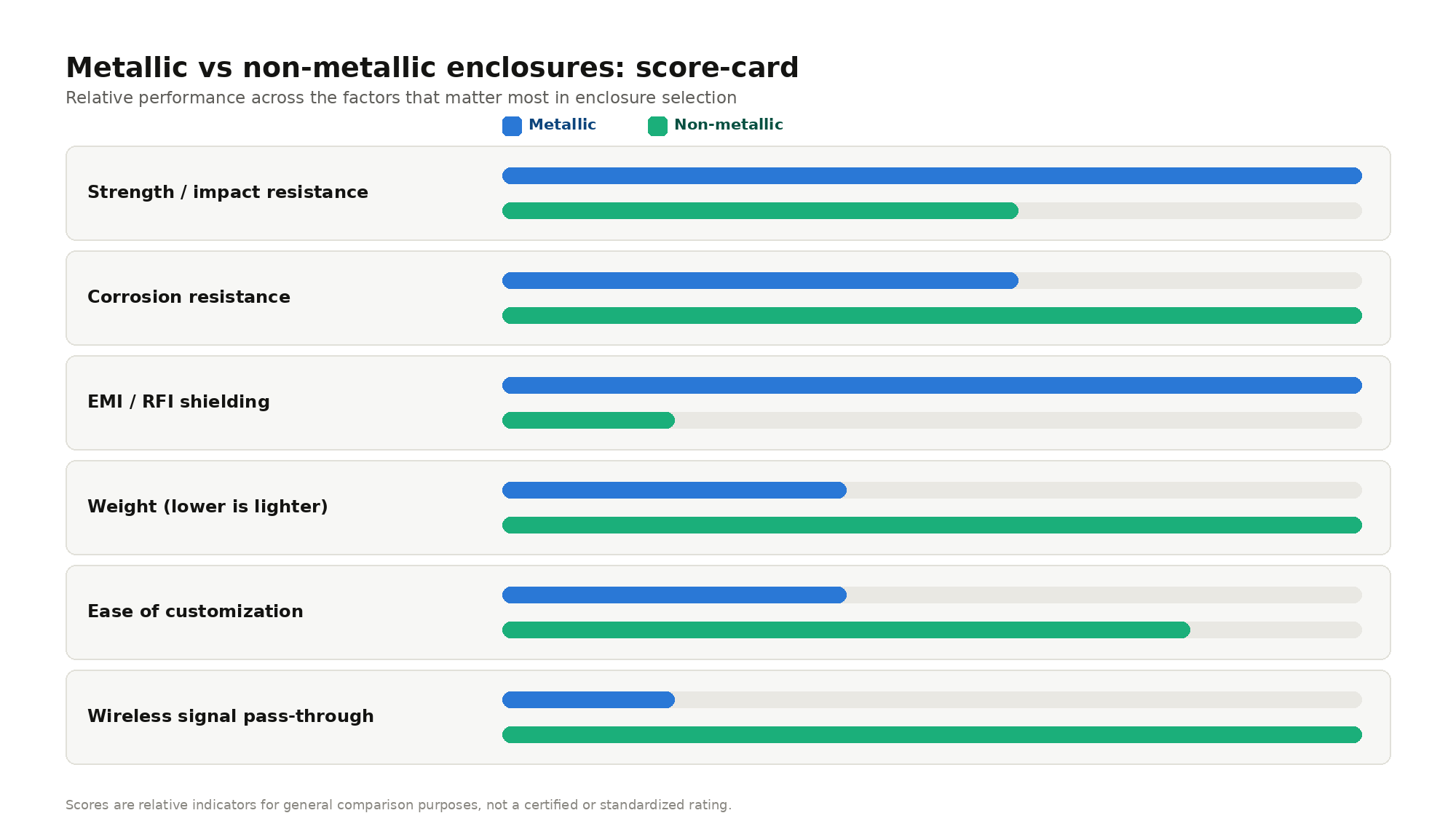
Fig 1 – Metallic vs non-metallic: score-card comparison
Factor | Metallic | Non-metallic |
Strength / impact resistance | High | Moderate |
Corrosion resistance | Depends on coating/grade | Naturally high |
EMI/RFI shielding | Yes, natural | No, needs add-on shielding |
Weight | Heavy | Light |
Upfront cost | Higher (especially SS316) | Lower |
Long-term cost in corrosive sites | Can rise sharply if under-specified | Stable |
Customization | Needs tooling/welding | Easier to drill/modify |
Wireless signal pass-through | Blocked | Passes freely |
Best use cases for each
Metallic enclosures fit best in:
- Heavy industrial settings with machinery impact risk
- EMI-sensitive control rooms and telecom infrastructure requiring shielding
- Sites needing long-term structural durability under load
Non-metallic enclosures fit best in:
- Food & beverage washdown areas where hygiene and corrosion resistance matter more than raw strength
- Telecom and wireless installations where signal pass-through is required
- Coastal, chemical, and wastewater sites with sustained corrosive exposure
Neither material family is a good fit on its own for classified hazardous areas – those applications need a separate layer of certification. See our guide to ATEX-certified enclosures for equipment selection where flammable gases or combustible dust are present.
Total cost of ownership – the question most comparisons skip
Most comparisons stop at sticker price. That’s an incomplete picture. A poorly coated mild steel enclosure installed in a coastal or chemical-heavy site can end up costing more over 5-7 years than a properly specified stainless steel or non-metallic enclosure – once early replacement, downtime, and reinstallation are factored in.
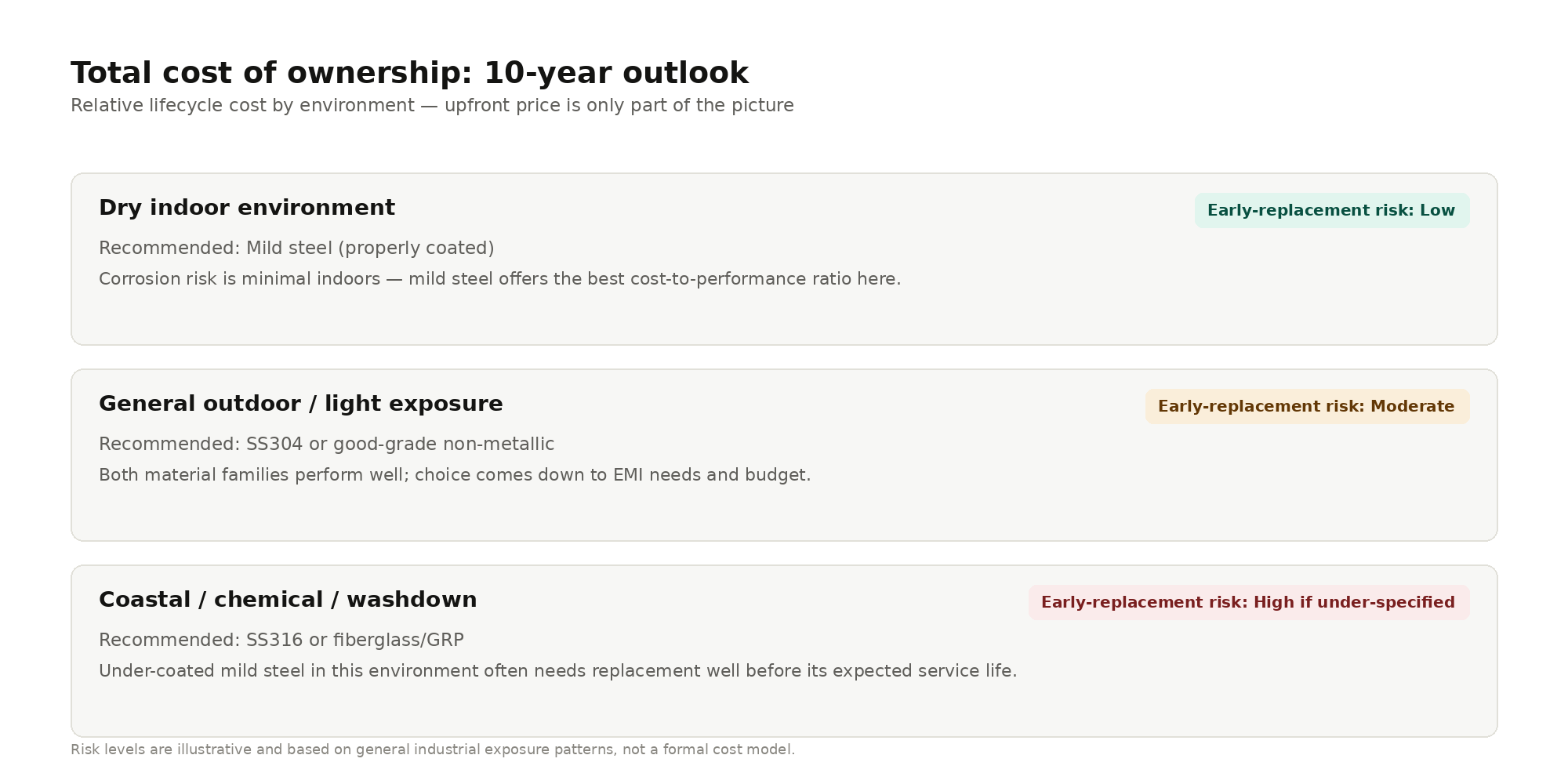
Fig 2 – Total cost of ownership: metallic vs non-metallic over a 10-year outlook, by environment
Environment | Recommended material | Early-replacement risk |
Dry indoor | Mild steel (properly coated) | Low |
General outdoor / light exposure | SS304 or good-grade non-metallic | Moderate |
Coastal / chemical / washdown | SS316 or fiberglass/GRP | High if under-specified |
This is where coating quality becomes as important as the base material decision. Enclosures built with advanced systems such as C4-H (high corrosivity) compliant powder coating are engineered specifically to extend service life in humid, salt-exposed, or chemically aggressive environments – closing the gap that often makes “cheaper” mild steel more expensive in the long run.
How to decide? (4-step framework)
- Define the environment. Corrosive, coastal, or chemical exposure points toward stainless steel or non-metallic; dry indoor conditions favor mild steel.
- Check if EMI shielding is actually required. Most general industrial applications don’t need it – reserve this requirement for telecom, control rooms, and EMI-sensitive equipment.
- Weigh upfront cost against expected service life in that environment. A lower purchase price in a high-corrosion site can quietly become the more expensive option.
- Confirm compliance needs. ISO 9001:2015 manufacturing standards, and hazardous-area certification (ATEX/PESO) if the application requires it.
Conclusion
Metallic and non-metallic enclosures each solve a different problem well, and neither is a universal answer. The material decision should start with the environment the enclosure will actually operate in – corrosion exposure, EMI sensitivity, and physical risk – with cost evaluated over the enclosure’s expected service life rather than at the point of purchase alone.
Frequently Asked Questions
1. Are non-metallic enclosures as strong as steel enclosures?
Not quite. Non-metallic enclosures like fiberglass and polycarbonate are durable for most industrial use, but they generally have lower impact resistance than steel or aluminum and can crack under heavy physical stress that metal would withstand.
2. Which enclosure type is better for outdoor use?
Both can work outdoors, but the deciding factor is the specific environment. Non-metallic enclosures handle general weather and moisture exposure well without corrosion risk, while properly coated stainless steel enclosures (SS304/SS316) are the stronger choice for outdoor sites with higher impact risk or extreme conditions.
3. Do non-metallic enclosures provide EMI/RFI shielding?
No, not inherently. Non-metallic materials don’t block electromagnetic interference the way metal does. If EMI shielding is required in a non-metallic enclosure, additional shielding material needs to be added separately.
4. Is stainless steel better than fiberglass for food plants?
Both are commonly used in food & beverage settings. Stainless steel (particularly SS316) is preferred where strength and a smooth, easily sanitized surface matter most; fiberglass is a lighter, cost-effective alternative in less demanding washdown areas. The right choice depends on the specific hygiene and impact requirements of the plant.
5. What does Bartakke recommend for corrosive environments?
For coastal, chemical, or heavy washdown environments, SS316 stainless steel enclosures with high-corrosivity-rated coating typically offer the best long-term performance. Non-metallic options are a suitable alternative where EMI shielding isn’t required and weight or cost are priorities.
6. Can non-metallic enclosures be used in hazardous or ATEX-classified areas?
Non-metallic enclosures can be used in some hazardous-area applications, but the material itself doesn’t provide ATEX certification – the enclosure needs to be specifically designed, tested, and certified for the relevant zone and gas group, regardless of whether it’s metallic or non-metallic.
Explore Bartakke’s mild steel enclosures (encloPRIME), stainless steel enclosures (encloINOX), and enclosures built for food & beverage industry environments – all manufactured under ISO 9001:2015 with IP65/IP66-rated protection as standard.