

Bartakke Enclosures
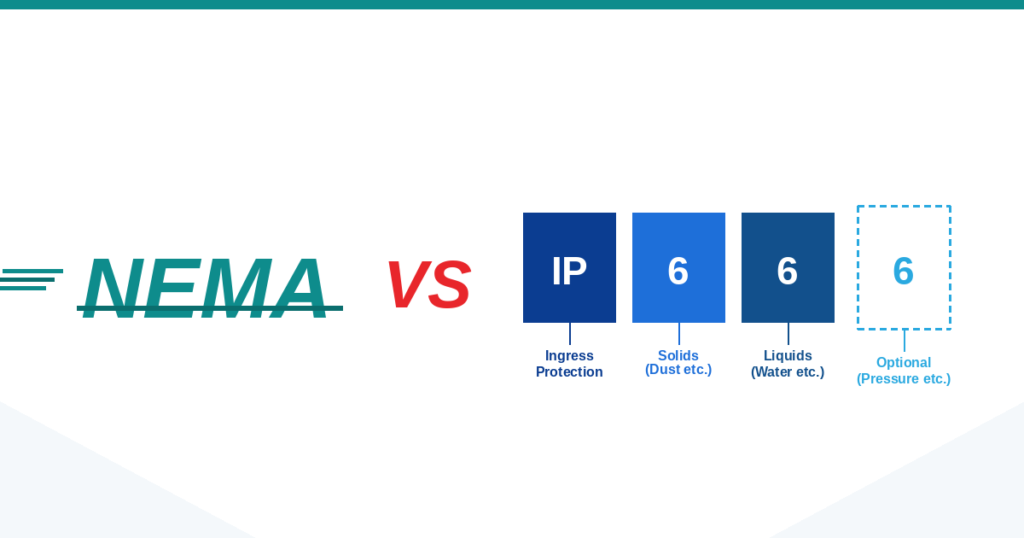
NEMA and IP ratings both describe how well an enclosure resists dust and water, but they come from different standards bodies and aren’t directly interchangeable. NEMA (from the National Electrical Manufacturers Association) is used mainly in North America, while IP (Ingress Protection, IEC 60529) is the global standard. Knowing how to read both — and where they overlap — is essential when specifying enclosures for export or multi-region projects.
Key takeaways
- NEMA and IP test different things — NEMA covers construction quality and corrosion protection in addition to ingress; IP tests ingress only.
- NEMA is a North American standard; IP (IEC 60529) is used globally, including India and the EU.
- There’s no exact 1:1 conversion between the two systems — only approximate equivalents.
- NEMA 4X and IP66 are the most commonly matched pair, but “closest equivalent” isn’t the same as “certified identical.”
- For export or multi-region projects, specify both ratings rather than assuming one implies the other.
NEMA vs IP at a glance
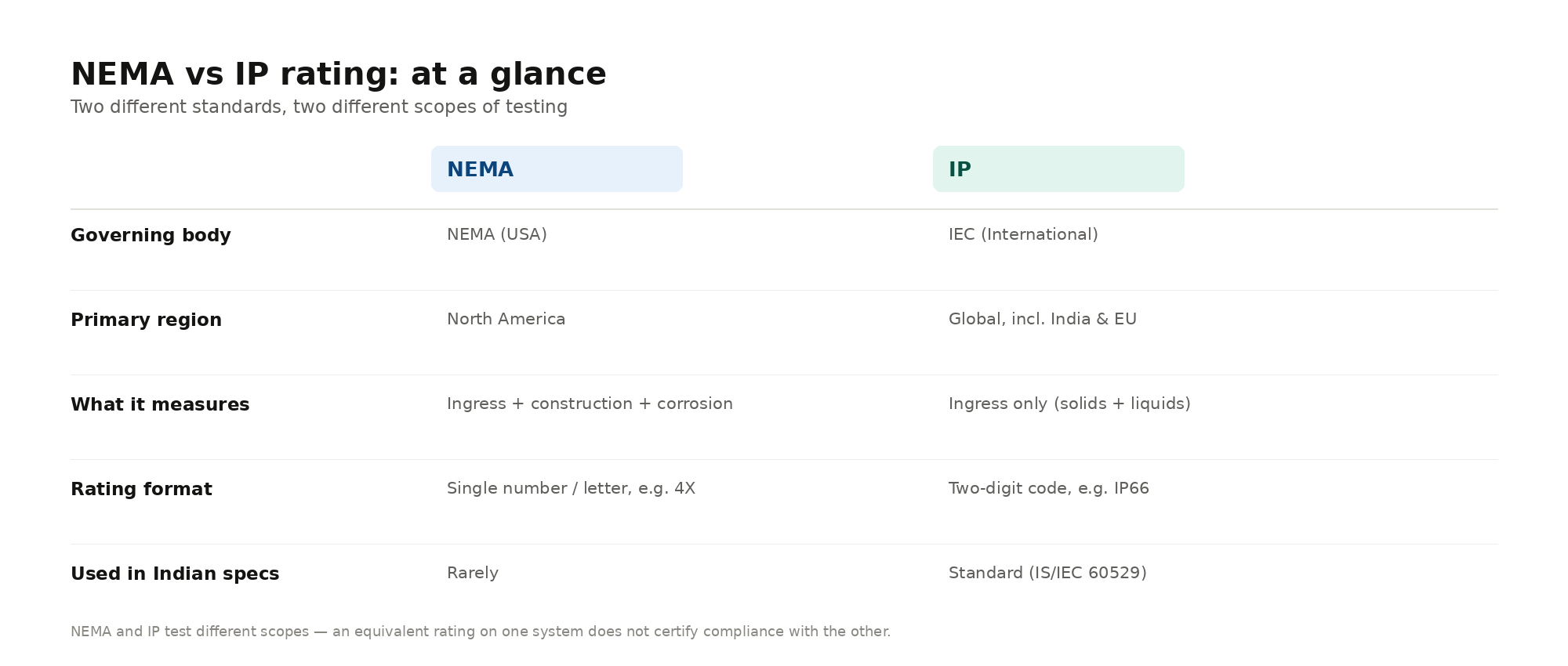
(NEMA vs IP rating: at a glance)
NEMA | IP | |
Governing body | NEMA (USA) | IEC (International) |
Primary region | North America | Global, including India and the EU |
What it measures | Ingress + construction + corrosion | Ingress only (solids + liquids) |
Rating format | Single number/letter, e.g. 4X | Two-digit code, e.g. IP66 |
Used in Indian specifications | Rarely | Standard (IS/IEC 60529) |
What do NEMA ratings mean?
NEMA ratings come from the National Electrical Manufacturers Association and are the standard reference for enclosure protection in the United States and Canada. Unlike IP, a NEMA rating isn’t only about keeping dust and water out — it also accounts for construction quality and, in certain types, corrosion resistance.
The types most commonly specified in industrial projects are:
- NEMA 1 — basic indoor protection against incidental contact and falling dirt
- NEMA 3R — outdoor protection against rain, sleet, and snow
- NEMA 4 — indoor/outdoor protection against windblown dust, splashing water, and hose-directed water
- NEMA 4X — everything in NEMA 4, plus corrosion resistance
- NEMA 12 — indoor protection against dust, dirt, and light splashing
What do IP ratings mean?
IP ratings come from IEC 60529 and are the standard used across most of the world outside North America — including India, where IP is referenced directly in Indian electrical specifications (IS/IEC 60529).
An IP rating uses two digits:
- First digit — protection against solid objects and dust, on a scale of 0-6
- Second digit — protection against liquids, on a scale of 0-9
Unlike NEMA, IP ratings focus purely on sealing performance. They don’t independently certify build quality, corrosion resistance, or the enclosure’s suitability for a specific end-use environment — that’s left to the buyer to evaluate alongside the IP number.
NEMA-to-IP equivalency table
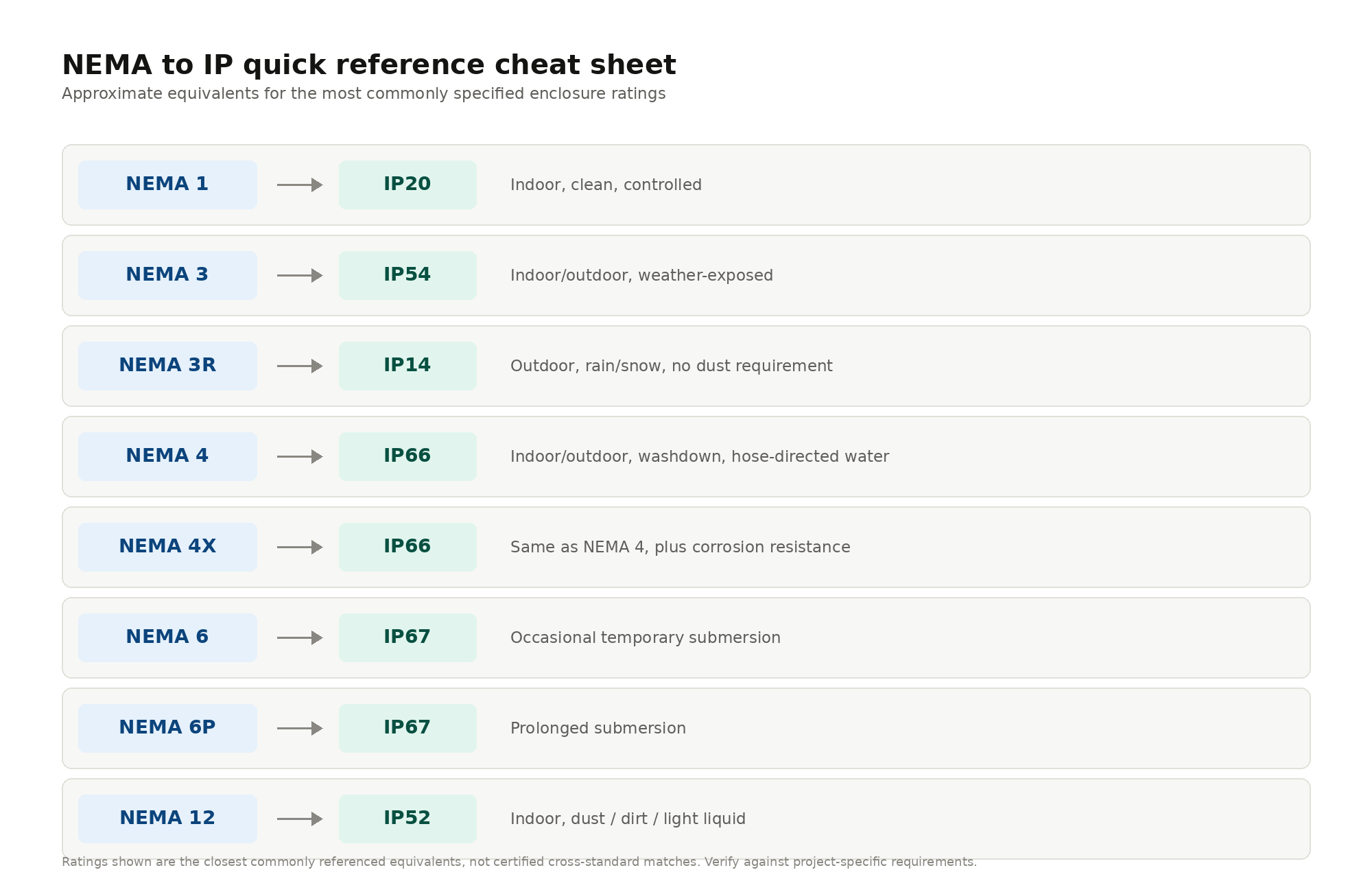
(NEMA to IP quick reference cheat sheet)
NEMA rating | Closest IP equivalent | Typical environment |
NEMA 1 | IP20 | Indoor, clean, controlled |
NEMA 3 | IP54 | Indoor/outdoor, weather-exposed |
NEMA 3R | IP14 | Outdoor, rain/snow, no dust requirement |
NEMA 4 | IP66 | Indoor/outdoor, washdown, hose-directed water |
NEMA 4X | IP66 | Same as NEMA 4, plus corrosion resistance |
NEMA 6 | IP67 | Occasional temporary submersion |
NEMA 6P | IP67 | Prolonged submersion |
NEMA 12 | IP52 | Indoor, dust/dirt/light liquid |
A NEMA rating and its closest IP equivalent are not certified as interchangeable — they’re approximate matches for reference only. When a project genuinely requires both standards, specify and test to both independently rather than assuming one automatically satisfies the other.
NEMA 4X vs IP66 — the most commonly confused pair
This is the single most frequently searched comparison in enclosure specification, and for good reason: NEMA 4X and IP66 are the closest match on the entire equivalency table, which makes them easy to treat as identical. They aren’t.
NEMA 4X specifically certifies corrosion resistance as part of its construction requirements — relevant for marine, chemical, and washdown environments. IP66 certifies dust-tight construction and protection against powerful water jets, but says nothing about the material’s resistance to corrosion over time. A stainless steel enclosure can be genuinely NEMA 4X and IP66 rated; a mild steel enclosure with a good gasket can pass IP66 testing without ever qualifying for NEMA 4X. If corrosion resistance matters for your application, check the material and corrosion certification separately from the ingress rating.
Where does ATEX/IECEx fit in?
NEMA and IP ratings tell you how well an enclosure resists dust and water. Neither says anything about whether an enclosure is safe to install in a hazardous area where flammable gases, vapours, or combustible dust may be present.
That’s a separate layer of certification entirely — ATEX (Europe) or IECEx (international), or PESO certification in India — and it sits on top of, not instead of, an IP rating. An enclosure for a Zone 1 hazardous area, for example, typically needs both an IP66 rating for environmental sealing and a matching Ex rating for the specific gas group and zone. If your project involves oil and gas, chemical processing, or battery manufacturing, it’s worth reviewing hazardous-area requirements separately — see our guide to ATEX-certified enclosures for zone classification and equipment selection.
How to choose the right rating for your project?
- Identify your project’s region and compliance expectations. A US client’s specification will typically reference NEMA; an Indian, EU, or export project will typically reference IP.
- Match the rating to your actual environment. Indoor, outdoor, washdown, or submersion — don’t over-specify a higher rating than the environment requires.
- Check if hazardous-area certification also applies. If flammable gases or combustible dust are present, IP/NEMA alone isn’t sufficient.
- When in doubt, or specifying for multi-region use, ask for both ratings on the datasheet. This removes ambiguity for procurement teams working across regions.
Common mistakes to avoid
- Assuming NEMA 4X and IP66 are certified equivalents — they’re a close match, not a guaranteed substitute for each other.
- Specifying only an IP rating for a North American project (or vice versa) without confirming what the client or regulatory body actually expects.
- Ignoring that NEMA also certifies corrosion resistance — a like-for-like IP-rated enclosure may still lack this.
- Over-specifying — for example, requesting IP67 for an indoor panel that will never face submersion, adding unnecessary cost.
Conclusion
NEMA and IP ratings solve a similar problem through two different systems, and the closest equivalents on paper still aren’t certified substitutes for each other. For projects specifying enclosures across regions, the safest approach is to identify both the required standard and the real environmental conditions, rather than relying on a conversion table alone.
Explore Bartakke’s enclosures for electrical and automation applications and food and beverage industry environments, both built to IP65/IP66 standards as a baseline. You can also download the NEMA-to-IP cheat sheet shared above for quick reference on your next project.
Frequently Asked Questions
1. What is the difference between NEMA 4 and NEMA 4X?
Both protect against windblown dust, splashing water, and hose-directed water. NEMA 4X adds a certified requirement for corrosion resistance, making it the better choice for marine, chemical, or heavily washed-down environments.
2. Is IP66 the same as NEMA 4X?
No. IP66 and NEMA 4X are the closest commonly matched pair, but IP66 only certifies dust and water ingress protection — it says nothing about corrosion resistance, which NEMA 4X specifically requires. An enclosure can be IP66 without meeting NEMA 4X’s corrosion standard.
3. Which rating should I use for outdoor enclosures?
For general outdoor use, IP65 or IP66 (or NEMA 3R/4 in North America) is typically sufficient. Coastal, chemical, or heavy washdown outdoor sites should specify IP66 with a corrosion-resistant material such as SS316, or NEMA 4X.
4. Do Bartakke enclosures carry both NEMA and IP certifications?
Bartakke enclosures are manufactured and tested to IP65/IP66 standards under ISO 9001:2015, aligned with the IEC 60529 framework used across Indian and export markets. For projects requiring NEMA certification specifically, our engineering team can advise on equivalent specification and testing requirements.
5. What rating is needed for washdown environments in food plants?
Food and beverage washdown areas typically require IP66 or NEMA 4X, paired with a stainless steel (SS304 or SS316) enclosure to handle both the water pressure and the cleaning chemicals used in daily sanitation cycles.
6. Can an enclosure be both IP66 and ATEX certified?
Yes, and for hazardous-area installations it usually needs to be. IP66 addresses environmental sealing while ATEX (or IECEx/PESO) certifies the enclosure’s suitability for a specific hazardous zone and gas group — the two certifications work together, not as alternatives.