

Bartakke Enclosures
ATEX and Purged Enclosures for Battery Recycling
Battery recycling plants are hazardous areas. Flammable gases, solvent vapours, combustible dust, and thermal runaway risks are part of everyday operations – and that makes the electrical equipment decisions inside these facilities critical. ATEX-certified equipment and purged enclosures are the two proven solutions that keep control systems, instrumentation, and personnel safe in these explosive atmospheres. Get the specification wrong and the consequences are severe. Get it right and the plant runs safely and compliantly. That is what this blog covers.
Battery recycling is one of the fastest-growing sectors in industrial manufacturing – and India is emerging as one of the fastest-moving markets, with recycling capacity scaling rapidly alongside its EV boom. Driven by the global shift to electric vehicles and renewable energy storage, demand for lithium-ion battery recycling is expanding across Europe, North America, Asia, and now aggressively across India. But as facilities scale up, one engineering challenge is consistently underestimated: hazardous area classification and the electrical equipment decisions that follow from it.
These are not clean, controlled environments. They are active industrial facilities where explosive atmosphere risks must be engineered out – not managed around. Let’s get into details.
What makes battery recycling a hazardous area?
The risks emerge at multiple stages of the recycling process. During cell dismantling and shredding, lithium-ion batteries release electrolyte vapours and potentially toxic off-gases including hydrogen fluoride. Dry processing of black mass – the valuable material recovered from spent cells – generates fine combustible dust that can accumulate and ignite. Thermal runaway, where a damaged or partially charged cell enters an uncontrolled exothermic reaction, can escalate quickly and unpredictably across a batch.
Each of these conditions can independently qualify an area as a classified hazardous zone under ATEX (Europe), IECEx (international), or NEC/NFPA (United States) standards. Together, they make a compelling case for treating the entire processing environment with serious engineering rigour from day one.
Understanding the zone classification
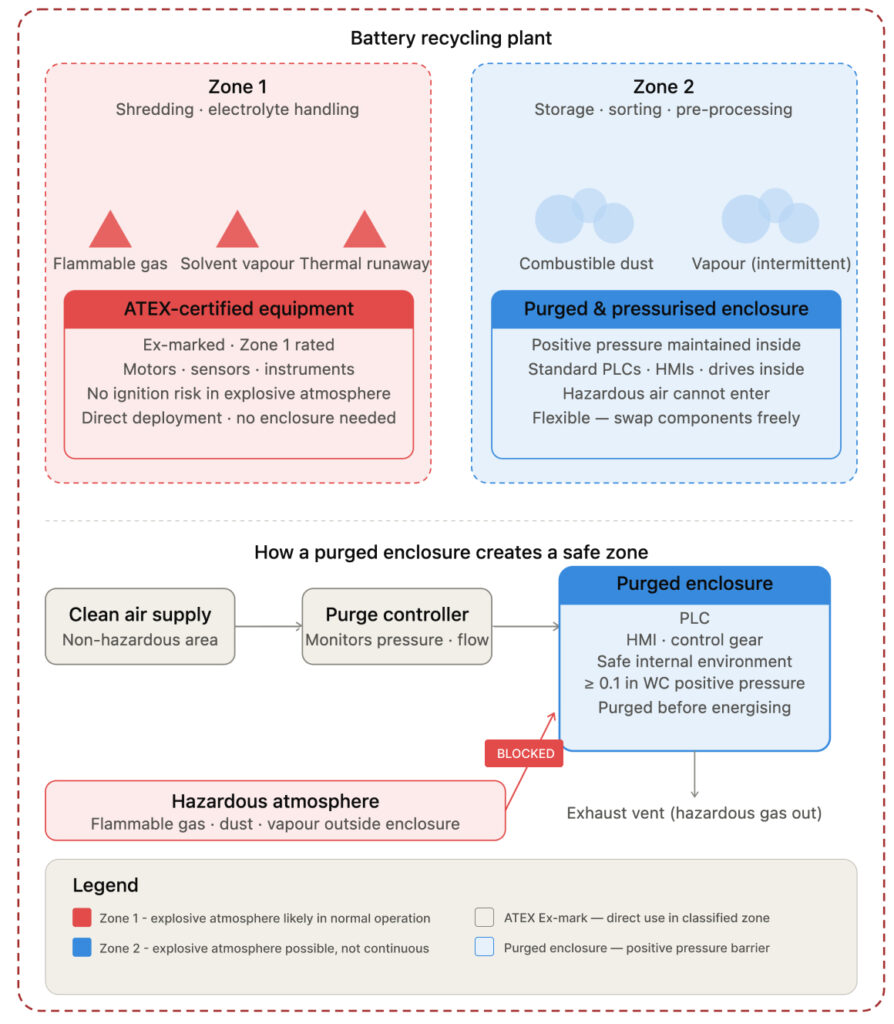
Hazardous areas are not classified uniformly across a plant. Zone classification depends on the likelihood and duration of explosive atmosphere presence in each specific area. Shredding lines and electrolyte handling zones typically fall under Zone 1, where flammable atmospheres are expected during normal operation. Storage, pre-processing, and general handling areas are often Zone 2, where the risk is present but less frequent. Black mass processing areas carry dust classifications – typically Zone 21 or Zone 22 depending on process design.
Every plant requires a formal zone map produced by a qualified engineer. That map then drives every downstream decision about electrical equipment, instrumentation, and control systems.
Two proven protection approaches
Once zones are established, plant designers have two primary strategies for protecting electrical equipment.
The first is ATEX-certified equipment – panels, enclosures, instruments, motors, and control devices that are independently tested and certified to prevent ignition within their rated zone. These carry the Ex marking and can be installed directly in classified areas without additional enclosure.
The second approach is purged and pressurised enclosures. Here, standard electrical equipment such as PLCs, HMIs, variable speed drives, and control gear is housed inside a specially designed enclosure. Clean air or inert gas is continuously supplied to maintain a positive internal pressure, preventing any hazardous atmosphere from entering. The interior of the enclosure is effectively treated as a non-hazardous environment, allowing standard components to operate safely inside Zone 1 and Zone 2 areas.
Purged enclosures are particularly well suited to battery recycling applications because the internal equipment is often sophisticated, regularly updated, and not readily available with native ATEX certification. They also offer flexibility – internal components can be changed without recertifying the entire assembly.
Image - From hazardous zones to safe enclosures, how ATEX certification and purge pressurisation protect electrical equipment in a battery recycling plant.
Getting the specification right
Battery recycling is still a young industry. Most commercial-scale plants have only recently come online, and engineering standards specific to this sector are still developing. The decisions plant designers make today – on zone classification, equipment protection strategy, and enclosure specification – are likely to become the baseline that the industry builds on.
Addressing hazardous area requirements at the design stage is straightforward. Retrofitting classified areas after commissioning is costly, disruptive, and sometimes not possible without significant redesign.
FAQ’s
1. Is a battery recycling plant classified as a hazardous area?
Yes. Battery recycling facilities generate flammable gases, electrolyte solvent vapours, combustible black mass dust, and thermal runaway risks during normal operation – all of which qualify process areas as ATEX Zone 1 or Zone 2 under EU directive 2014/34/EU, or Class I Division 1/2 under NEC/NFPA in North America.
2. What ATEX zone is a lithium-ion battery recycling facility?
It depends on the process area. Shredding lines and electrolyte handling zones typically classify as Zone 1 – where explosive atmospheres are likely during normal operation. Storage, sorting, and pre-processing areas often fall under Zone 2. Black mass handling areas carry dust zone classifications, usually Zone 21 or Zone 22.
3. What electrical equipment is required in a battery recycling plant?
All electrical equipment installed in classified zones must either carry ATEX or IECEx Ex certification rated for that specific zone, or be housed inside a purged and pressurised enclosure (Ex p) that creates a safe internal environment. Standard uncertified equipment cannot be used directly in hazardous areas.
4. What is a purged enclosure and how does it work in hazardous areas?
A purged and pressurised enclosure (Ex p) uses clean compressed air or inert gas to maintain a positive internal pressure above the surrounding atmosphere. This prevents hazardous gases, vapours, or dust from entering the enclosure. Standard PLCs, HMIs, and control gear can operate safely inside – eliminating the need for fully ATEX-certified internal components.
5. What is the difference between ATEX-certified equipment and a purged enclosure?
ATEX-certified equipment is individually tested and marked for direct use in a specific zone – no additional housing required. A purged enclosure takes standard, non-ATEX equipment and creates a safe zone around it using positive pressure. Purged enclosures are often preferred when equipment is complex, frequently updated, or not readily available with native Ex certification.
Q6. Does a purged enclosure need ATEX certification itself?
Yes. The purge controller, enclosure assembly, and pressurisation system must be certified by a recognised Notified Body (EU) or Approved Body (UK) for Category 2 systems (Ex pxb and Ex pyb). The enclosure must also meet a minimum IP54 or IP65 rating to maintain internal pressure integrity. Self-certification is only permitted for Category 3 Ex pzc systems by a competent person.
7. When should battery recycling plant designers specify ATEX equipment vs purged enclosures?
Specify ATEX-certified equipment when the device is simple, available with Ex marking, and installed permanently in Zone 1. Choose purged enclosures when the control system is complex – such as a PLC panel with an HMI and drives – where sourcing every internal component with native ATEX certification would be costly, slow, or impractical. Many battery recycling plants use both approaches depending on the equipment type and location.