

Bartakke Enclosures
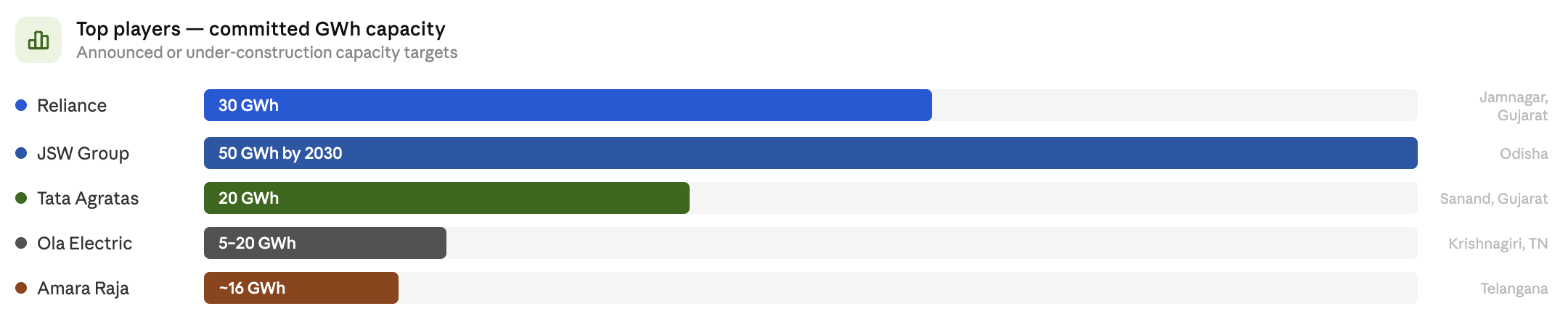
India is building gigafactories at a pace nobody expected a decade ago. Reliance in Jamnagar. Tata in Sanand. Ola Electric in Tamil Nadu. Amara Raja in Telangana. The country is targeting over 290 GWh of battery manufacturing capacity across 30+ sites by 2030. (Source: PV Magazine India, Feb 2026)
The clean energy story is real. But buried inside it is a hazard profile that most project teams are completely unprepared for – and ignoring it is expensive.
Battery gigafactories are classified hazardous areas. Just like oil refineries.

The chemistry nobody talks about
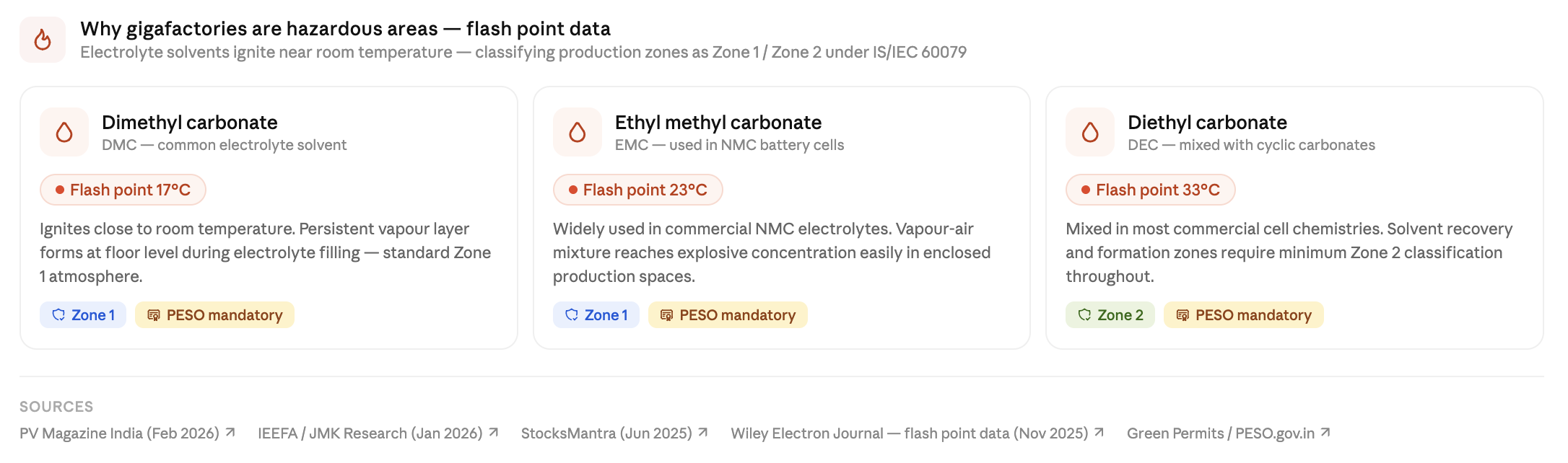
A lithium-ion battery is essentially a flammable liquid packaged very carefully. The electrolyte – the substance that makes the battery work – is made from organic carbonate solvents: dimethyl carbonate (DMC), ethyl methyl carbonate (EMC), and diethyl carbonate (DEC).
These solvents have flash points of 17°C, 23°C, and 33°C respectively. They evaporate at room temperature and form explosive vapour-air mixtures in enclosed spaces.
At an electrolyte filling station inside a gigafactory, lithium salt solvents produce a persistent vapour layer at floor level under completely normal operating conditions. This is not a worst-case scenario. This is every working day.
Under IS/IEC 60079 standards – the same framework applied to petroleum refineries – electrolyte filling, mixing, formation charging, and solvent recovery zones classify as Zone 1 or Zone 2 hazardous locations. Every electrical item installed there must be explosion-protected and certified accordingly.
The ATEX/PESO requirement that surprises everyone
In India, this is not a recommendation. It is law.
Rule 106 of the Petroleum Rules 2002 states that all electrical equipment installed in explosive or potentially explosive atmospheres requires CCOE approval – issued by PESO, the Petroleum and Explosives Safety Organisation. This applies equally to petrochemical plants, LPG terminals, and battery factories handling flammable electrolyte solvents.
ATEX or IECEx certification alone is not sufficient for installation in India. PESO/CCOE approval is a separate, mandatory step. With complete documentation, the process takes 4–8 weeks. Without it – or with mismatched certificates – approvals slip by months, directly delaying commissioning.
The scale of what is coming makes this urgent. India’s total disclosed investment in gigafactory projects already exceeds ₹20,000 crore. Yet as of October 2025, only 2.8% of the government’s 50 GWh ACC PLI target had been commissioned – largely because of supply chain, compliance, and implementation bottlenecks. Electrical equipment compliance is one more variable that, handled late, becomes a critical-path problem.
What ATEX/PESO-rated enclosures actually do here
Three protection concepts apply directly to gigafactory environments:
Ex d (Flameproof): Contains any internal explosion and prevents it from reaching the surrounding atmosphere. Required for motor starters, distribution boards, and switchgear in Zone 1 areas.
Ex e (Increased Safety): Prevents sparking and overheating through design. Used for terminal enclosures and lighting in Zone 2 areas.
Ex p (Purge & Pressurisation): Maintains positive air or inert gas pressure inside the enclosure, keeping flammable vapour out. Allows standard PLCs, drives, and HMIs to be safely housed in classified zones – a cost-effective alternative to fully certified Ex-d equipment throughout.
The window to get it right is at design stage
Battery factory projects in India are moving fast. EPC teams often come from automotive or consumer electronics backgrounds, where hazardous area classification is not standard thinking.
The result: area classification studies get deferred. “Later” becomes post-commissioning. And retrofitting a running gigafactory with PESO-certified flameproof enclosures – replacing, rewiring, recertifying – costs many times more than specifying correctly from day one.
Lithium is the new oil and gas. The hazard profile is comparable. The legal obligation in India is identical. The enclosure specification cannot be an afterthought.
Talk to Bartakke Enclosures before your project hits procurement. We supply ATEX-aligned, PESO-ready flameproof and weatherproof enclosures + Purge Enclosures – and we work with project teams at the design stage, when getting it right is still easy.