

Bartakke Enclosures
Data Center Cabinets and Racks – Manufacturer Guide
Everything You Need to Know Before Choosing the Right Partner**
Modern data centers demand equipment that delivers stability, airflow control, cable management and security without compromise. As digital infrastructure grows across cloud, IT, telecom and enterprise environments, the need for reliable data center cabinets and racks has become more important than ever.
This guide explains what data center racks and cabinets are, why they matter and how to choose a manufacturer you can trust. If your business depends on secure and uninterrupted operations, the right cabinet partner becomes a strategic choice, not just a purchase.
1. Understanding Data Center Racks
Data center racks are metal frameworks designed to hold servers, switches, storage systems and networking devices in a stable, organized structure.
Racks maintain order, optimize airflow and ensure easy access for maintenance. Their primary purpose is to keep hardware secure while supporting consistent performance. Open racks are widely used in environments where cooling efficiency and accessibility are high priorities.
2. Understanding Data Center Cabinets
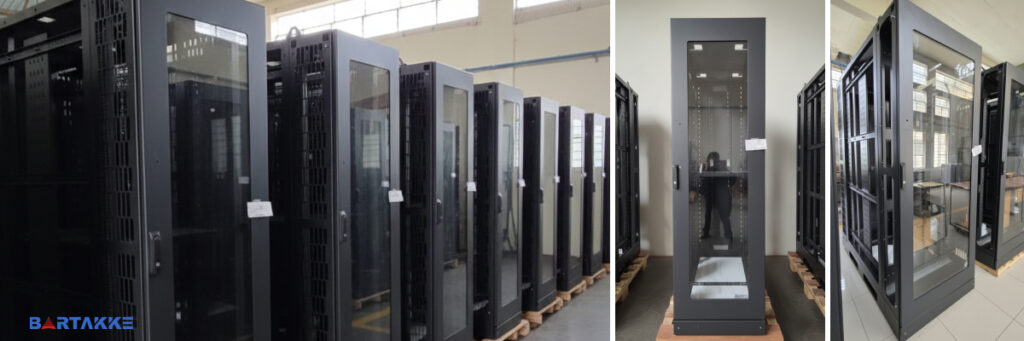
Data center cabinets are enclosed units that house IT and network equipment. They offer a controlled environment through side panels, front and rear doors and optional locks. Cabinets are essential for businesses that need physical security, noise reduction, dust protection or advanced thermal management.
A well-built cabinet protects high-value hardware and ensures reliable uptime even during demanding operations.
3. Key Differences Between Racks and Cabinets
Although racks and cabinets serve a similar purpose, they are designed for different operational needs.
- Racks are open frames while cabinets are enclosed structures with doors and panels.
- Racks allow maximum airflow and quick access, whereas cabinets support controlled cooling and physical protection.
- Racks are preferred in secure server rooms with dedicated cooling, while cabinets fit best in mixed or exposed environments.
Understanding these differences helps you select the right option for your data center layout.
4. Why Your Manufacturer Matters
Choosing a data center cabinet and rack manufacturer is a long-term infrastructure decision. A capable manufacturer provides engineering support, customization and reliable delivery.
Look for teams that understand structural stability, cable routing, weight load distribution, cooling needs and industry-standard components. Consistent manufacturing quality ensures fewer maintenance issues and better system uptime.
5. Features to Look for in Data Center Cabinets and Racks
When evaluating options, make sure the manufacturer offers:
- Strong load-bearing capacity for modern high-density servers
- Optimized cable management trays and pathways
- Proper airflow systems such as perforated doors, vented panels or thermal zones
- Compatibility with global rack unit standards
- Flexible power distribution options and mounting rails
- Secure locking systems and accessories for safety
- Custom sizing and design based on your data center layout
- Durable surface finishing to prevent corrosion and wear
- Easy installation and maintenance access
These features directly influence equipment performance and long-term reliability.
6. When You Should Choose Custom Cabinets or Racks
Every data center is built differently. If your servers require special airflow patterns, cable routing or weight support, custom manufacturing becomes important.
Custom cabinets are useful when handling:
- High-density server setups
- Mixed equipment brands and sizes
- Space-restricted or phased expansion environments
- Special cooling strategies such as hot aisle or cold aisle containment
- Security requirements for telecom and enterprise clients
A manufacturer who offers customization provides better control and future scalability.
7. Industries That Depend on High-Quality Data Center Cabinets and Racks
Modern digital operations rely heavily on stable hardware setups. These industries depend on durable cabinets and racks every day:
- Cloud service providers and colocation facilities
- IT and software development companies
- Telecom and internet service providers
- Banking and financial institutions
- Government data centers
- Healthcare systems handling sensitive records
- E-commerce and large enterprise networks
Each of these environments needs equipment that performs consistently and safely.
8. How the Right Cabinets Improve Data Center Performance
Reliable cabinets lead to better overall infrastructure performance. They support optimized airflow, increased equipment life and reduced downtime. Structured cable management minimizes errors and speeds up troubleshooting. Security add-ons such as locks, sensors and monitoring systems protect critical hardware.
Over time, the right enclosures reduce operational costs by preventing overheating, hardware damage and maintenance delays.
9. How to Choose the Best Data Center Cabinet and Rack Manufacturer
When selecting a manufacturer, evaluate:
- Experience in data center enclosure design
- Consistency in fabrication and quality control
- Ability to handle custom requirements
- Strong engineering and technical support
- Proven installations across industries
- Transparent communication, timelines and pricing
- Compliance with industry standards
A manufacturer who understands your operational challenges becomes a dependable long-term partner.
Frequently Asked Questions
1. What are racks in a data center?
Racks are open metal frames used to mount servers, switches and IT equipment. They offer maximum airflow, easy access and organized hardware stacking.
2. What is a cabinet in a data center?
A cabinet is an enclosed structure that houses IT and network equipment. It offers security, controlled airflow, cable management and better protection from dust and physical interference.
3. What is the difference between racks and cabinets in a data center?
Racks are open and focus on cooling efficiency and easy maintenance. Cabinets are closed and provide physical security and controlled thermal management. The choice depends on your environment and equipment needs.
4. Why is airflow so important in data center enclosures?
Proper airflow prevents overheating, extends equipment life and ensures stable performance under heavy workloads.
5. When should I choose custom racks or cabinets?
You should choose custom solutions when your data center has unique space, cooling or hardware requirements that standard products cannot meet.